Jordan Henderson
07-27-2026
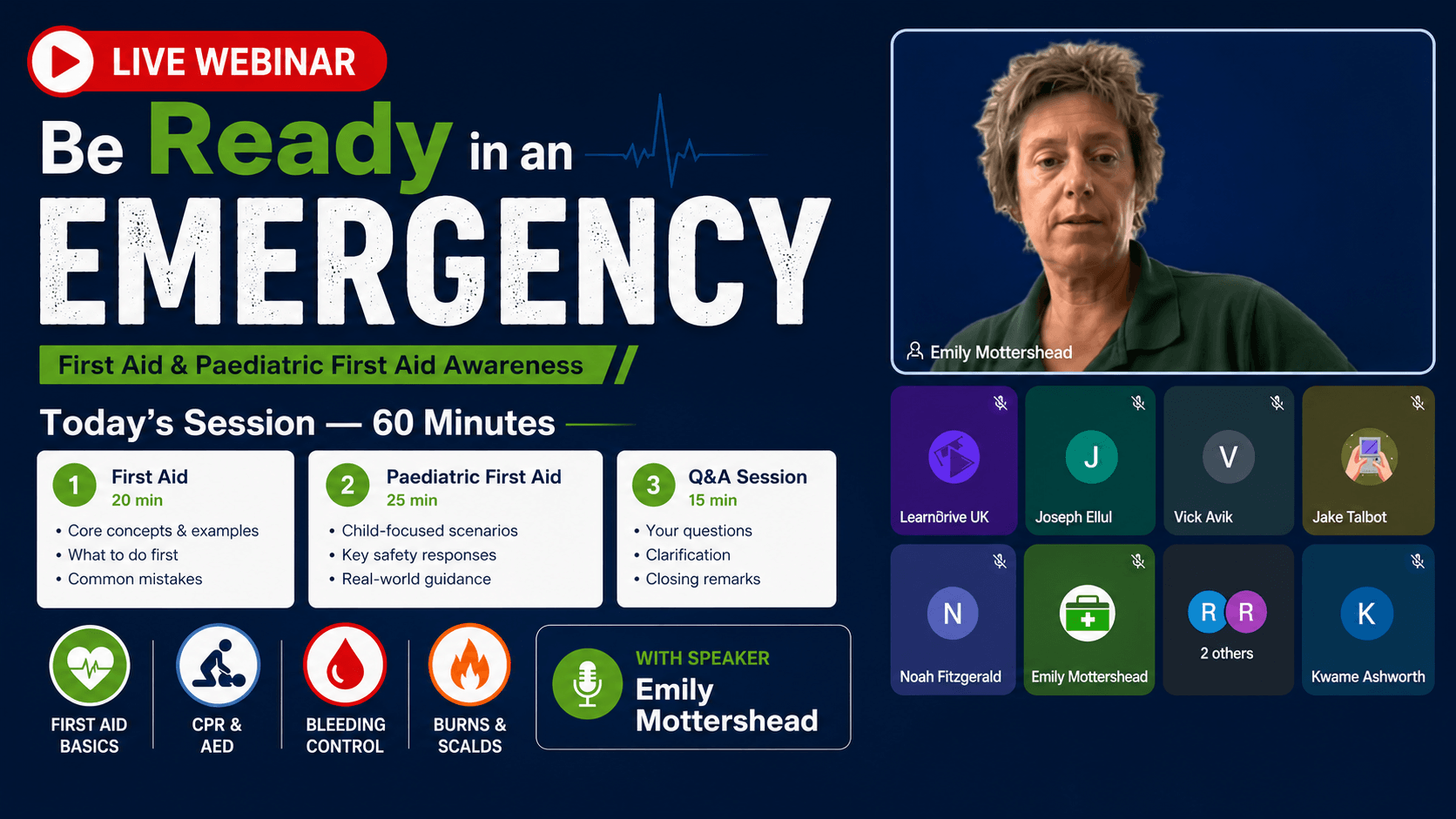
The “Be Ready in an Emergency” webinar opened with a practical introduction to first aid, setting the tone for a session focused on helping participants understand how to respond confidently during emergencies before professional medical assistance arrives.
Hosted online and presented by Emily Mottershead, the opening session brought together attendees from different backgrounds to explore the core principles of first aid through clear explanations and real-life examples. Supported by LearnDrive, EMT First Aid, EdTech Learning Limited and CPDQE, the webinar aimed to improve public awareness of life-saving skills that anyone may need to use.
The presentation began with an overview of the day’s agenda, which was divided into three sections: general first aid, paediatric first aid and a live question-and-answer session. The speaker explained that the first part would concentrate on the essential actions every person should understand when responding to an emergency.
One of the first topics discussed was the foundation of first aid, commonly known as the Three Ps.
Emily Mottershead explained that effective first aid is built around three priorities:
Throughout the discussion, the speaker stressed that the first few minutes following an incident are often the most important, making early action critical.

The webinar then moved to one of its most important subjects: responding when someone is not breathing normally.
Participants were introduced to the basic principles of cardiopulmonary resuscitation (CPR), including the recommended compression-to-breath ratio of 30 compressions to 2 rescue breaths. Emily also highlighted the importance of maintaining a compression rate of 100 to 120 compressions per minute, helping attendees understand the pace required during CPR.
Attention then turned to the Automated External Defibrillator (AED). Rather than viewing the device as something only healthcare professionals should use, participants were encouraged to recognise that modern AEDs provide clear voice instructions designed to guide members of the public through each step until emergency services arrive.
The discussion reinforced the message that quick action, combined with confidence in using available equipment, can make a significant difference during cardiac emergencies.
The final section of the opening presentation focused on two emergencies that many people may encounter: severe bleeding and burns or scalds.
For severe bleeding, the speaker demonstrated the importance of applying firm direct pressure to the wound, monitoring the casualty and contacting emergency services if bleeding could not be controlled.
When discussing burns, participants were advised to cool the affected area under running water for around 20 minutes, remove jewellery or restrictive clothing where appropriate and avoid applying creams, butter or ice to the injury. Emily also reminded attendees that children with burns should always receive medical assessment, particularly where injuries are extensive or involve sensitive parts of the body.
Rather than relying on myths or outdated advice, the session focused on simple, evidence-based actions that members of the public can remember during stressful situations.
Mottershead began by outlining several reasons why paediatric emergencies require particular care.
Children have smaller airways, which means an object such as a coin or a small piece of food may create a serious blockage. They may also deteriorate faster than adults, leaving less time to wait and observe when warning signs appear.
Communication presents another challenge. Babies and younger children may be unable to describe pain, breathing difficulty or other symptoms. Participants were therefore encouraged to observe behaviour, breathing and body colour for signs that something may be wrong.
The speaker also explained that first aid techniques should be gentler and adapted to the casualty’s age. Methods used for a baby under one year old differ from those used for a child or adolescent.
A central section of the presentation focused on cardiopulmonary resuscitation for babies, children and adolescents.
Attendees were shown that paediatric CPR may begin differently from adult CPR, with initial rescue breaths taking greater importance because children are more likely to experience breathing failure before cardiac arrest.
For babies, the session described the use of two fingers in the centre of the chest, with compression depth adjusted to the size of the infant. For children, the heel of one hand may be used, while adolescents showing signs of puberty are generally treated using adult methods.
The presentation compared compression methods, depth and rhythm across age groups, helping participants understand why a single CPR technique cannot be applied to every casualty.
The session also stressed that anyone responding alone should act promptly, begin CPR and contact the emergency services as soon as possible.
Choking was another major topic covered during the paediatric section.
For a choking baby, the speaker described positioning the infant face down along the responder’s forearm, supporting the head and delivering back blows between the shoulder blades. Chest thrusts may follow if the obstruction remains.
The webinar made clear that abdominal thrusts should not be used on babies.
For older children and adolescents, participants were advised to encourage coughing first where possible. Back blows and age-appropriate abdominal thrusts may then be required if the blockage does not clear.
The speaker emphasised that emergency services should be contacted when choking continues and that medical assessment may still be necessary after abdominal thrusts have been used.

The presentation then moved beyond CPR and choking to several conditions that can become urgent in children.
Febrile seizures were discussed alongside the need to protect the child from injury, avoid placing anything in the mouth and monitor the duration of the episode.
The session also addressed croup and breathing problems, noting that a child who struggles to breathe requires urgent medical attention.
Severe allergic reactions formed another key topic. Participants were reminded that an adrenaline auto-injector should be used promptly when prescribed and that emergency services must then be contacted.
Possible meningitis signs were also highlighted, including a rash that does not fade under pressure, neck stiffness and sensitivity to light. The speaker treated these as warning signs requiring immediate action rather than a wait-and-see approach.
The final section focused on applying paediatric first aid awareness in everyday environments.
Head bumps and falls were used as examples of incidents that require continued observation. Participants were encouraged to monitor children for unusual drowsiness, vomiting, confusion or other concerning changes after an injury.
The webinar also recommended maintaining a suitable first aid kit containing practical items such as plasters, dressings, gloves and cling film.
Knowing the appropriate contact number was presented as another essential part of emergency readiness. The speaker distinguished between calling 999 for emergencies, using 111 for urgent advice and keeping a GP’s contact details readily available.
Throughout the paediatric session, Mottershead repeatedly returned to the importance of confidence.
The speaker acknowledged that emergencies involving children can be frightening, particularly for parents, teachers, carers and childcare professionals. However, the webinar encouraged attendees to take appropriate action rather than become paralysed by uncertainty.
The message was simple: doing something appropriate is often better than doing nothing while a child’s condition worsens.
The “Be Ready in an Emergency” webinar concluded with an interactive live question-and-answer session, allowing attendees to seek clarification on real-life situations that many parents, carers, teachers and childcare professionals may encounter.
After completing the presentations on general first aid and paediatric emergencies, speaker Emily Mottershead invited participants to submit their questions, turning the final part of the webinar into a practical discussion based on everyday concerns rather than theory alone.
The session reinforced many of the key lessons covered earlier while providing additional guidance on common scenarios where people often feel uncertain.
One of the first questions focused on how hard chest compressions should be during infant CPR.
Emily explained that the amount of pressure should always be appropriate for the baby’s size. Rather than concentrating on force alone, she encouraged participants to focus on using the correct technique and compression depth while maintaining a steady rhythm.
The response reinforced an important message repeated throughout the webinar: correct technique is more important than excessive force.
Another attendee asked how long CPR should be continued before professional help arrives.
The speaker explained that CPR should continue until one of several things happens:
Emily reminded participants that maintaining continuous CPR can significantly improve a person’s chances of survival while waiting for emergency services.
Parents also raised concerns about head injuries, asking what should be done if a child appears well after a fall.
Emily advised that even when a child initially seems fine, they should still be observed carefully during the following hours.
She encouraged parents and carers to watch for warning signs such as unusual drowsiness, repeated vomiting, confusion, worsening headache or changes in behaviour. If these symptoms develop, medical advice should be sought immediately.
The discussion highlighted that careful observation can be just as important as immediate treatment following some childhood injuries.

The final question centred on dehydration in children, particularly how to recognise the condition before it becomes serious.
Emily explained that early signs may include:
Participants were encouraged to act early by offering fluids where appropriate and seeking medical advice if symptoms worsened or the child showed signs of severe dehydration.
As the live session drew to a close, Emily thanked participants for their engagement and encouraged them to continue developing their first aid knowledge through regular training and practical refreshers.
Across all three sessions, the webinar delivered a consistent message: emergencies often happen unexpectedly, but preparation, knowledge and confidence can make a meaningful difference before professional medical help arrives.
From understanding the principles of first aid to learning paediatric CPR, managing choking and discussing real-life questions from attendees, the “Be Ready in an Emergency” webinar provided practical guidance designed to help people respond more confidently when every second counts.

Jordan Henderson is a well-known writer and CPD research analyst with extensive experience creating insightful content on professional development, workplace learning, leadership, compliance, and skills development.