Reflective practice is the engine that turns CPD hours into real professional growth. Without it, CPD becomes a box-ticking exercise — attend a course, log the hours, move on. With it, every course, workshop, or webinar feeds back into how you actually think and work.
In short: reflective practice is the mechanism CPD relies on to prove that learning has actually happened. CPD gives you the activity — a course, a workshop, a mentoring session. Reflective practice is what turns that activity into evidence of change: what you learned, how it altered your thinking, and what you’ll do differently as a result. That’s why CPD frameworks like CPDQE’s build self-reflection directly into the certification process, rather than treating it as an optional extra.
This guide breaks down exactly how the two connect, what reflective practice looks like in a CPD context, and how to build it into your own professional development so it counts for more than just a certificate on file.
What Is Reflective Practice in the Context of CPD?
Reflective practice, in a CPD context, means deliberately reviewing a learning experience to identify what you understood, what changed in your thinking, and how you’ll apply it at work. It’s the difference between saying “I attended the course” and being able to explain what the course actually changed about how you do your job.
This isn’t a vague, feel-good exercise. Structured reflection typically asks three questions:
- – What happened? A factual account of the CPD activity and what it covered.
- – So what? What did it mean for you — what did you understand or realise that you hadn’t before?
- – Now what? What will you do differently in your role because of it?
This model (often traced back to Gibbs’ Reflective Cycle in professional education) is why so many CPD schemes ask for a short written reflection rather than just a certificate of attendance. The certificate proves you were in the room. The reflection proves you got something out of being there.
Why Do CPD Frameworks Require Reflection Instead of Just Attendance?
CPD frameworks require reflection because attendance alone doesn’t prove learning — reflection is the evidence that a course produced a measurable change in knowledge, skill, or practice. Regulators and accrediting bodies learned this the hard way: CPD schemes that only tracked hours produced professionals who’d sat through content without absorbing or applying any of it.
This is exactly why the CPDQE certification framework builds reflection into its validation mechanisms, not just its post-course paperwork. Under CPDQE’s assessment and validation standards, courses are expected to include self-reflection opportunities for learners — for example, asking participants to write a short reflection on how they’ll apply what they learned in their job. That single exercise does two jobs at once: it reinforces the learning for the participant, and it gives the provider real evidence of the course’s practical impact.
That evidence matters for three groups:
- – The learner — a reflection creates a record they can point to during appraisals, revalidation, or job applications.
- – The provider — reflections (alongside quiz results and feedback forms) show whether the course is actually landing, feeding into the ongoing quality assurance and course review process.
- – The regulator or professional body — where CPD is tied to license renewal, reflective statements are often the actual audit evidence requested, not just a log of hours.
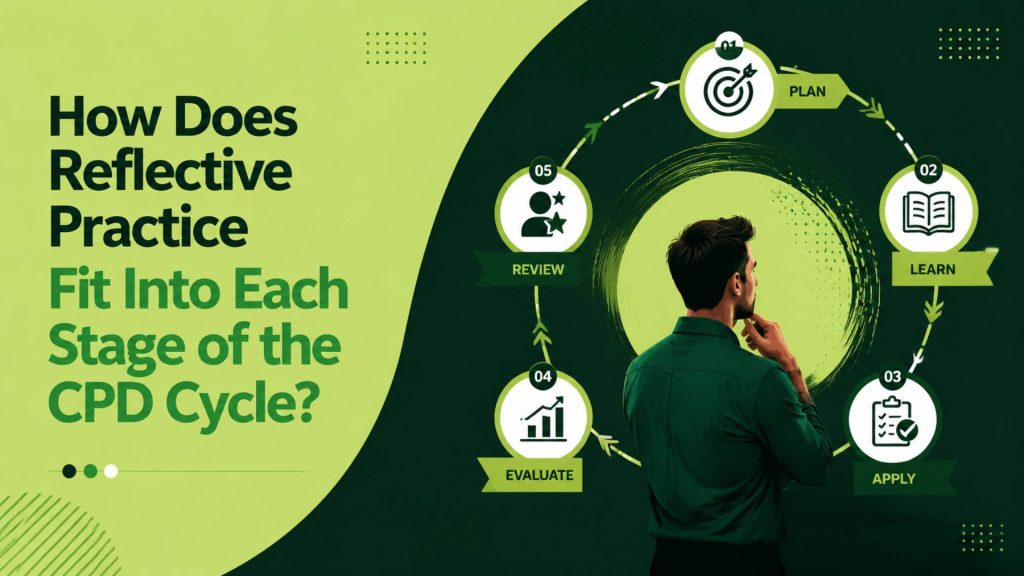
How Does Reflective Practice Fit Into Each Stage of the CPD Cycle?
Reflection isn’t a single step at the end of a course — it belongs at three distinct points in the CPD cycle: before the activity (identifying the gap), during or immediately after it (processing the new learning), and well after it (assessing whether it changed your practice).
Before: identifying the learning need. Good CPD starts with a reflective question — “where is my knowledge weakest right now, and what’s the cost of leaving that gap?” This is what turns CPD from a generic checklist into targeted development, and it’s the reason CPD providers ask about learning outcomes and prior experience during course submission.
During and immediately after: consolidating the learning. This is the “so what” stage — the short written reflection CPDQE-aligned courses ask for, the self-assessment quiz, the debrief discussion. Immediately after a session is when reflection is most effective, because the material is still fresh and specific rather than a vague memory of “a useful course.”
Later: auditing real-world impact. Weeks or months after the course, effective reflective practice asks whether the change actually stuck. Did you use the new regulation, technique, or framework in practice? This later reflection is what feeds the re-evaluation and continuous improvement responsibilities that sit with providers post-certification — and it’s the strongest evidence a professional can offer that CPD wasn’t just a certificate exercise.

What Does Good Reflective Practice Actually Look Like?
Good reflective practice is specific, honest, and tied to action — not a generic paragraph praising the course. A strong reflective entry names the exact idea or skill gained, describes a real situation where it applies, and states a concrete next step.
Compare these two reflections from the same course on updated data protection regulations:
Weak: “The course on data protection was informative. I learned a lot about the new regulation and would recommend it to colleagues.”
Strong: “Before this course, I didn’t realise our current client consent forms don’t cover the updated retention requirements. Next week I’ll review our consent template with the compliance team and flag the gap before our Q3 audit.”
The second version does what a reflective statement is meant to do: it names a specific misconception that was corrected, and it commits to a specific action with a timeframe. That’s the level of detail that satisfies both a genuine learning need and, where required, an auditor or accrediting body.
A useful format to structure this:
- What I thought before: your prior understanding or assumption.
- What changed: the specific new knowledge or skill.
- Where it applies: a real task, client, or situation in your current role.
- What I’ll do next: one concrete action, ideally with a date attached.

How Can Training Providers Build Reflection Into Their CPD Courses?
Providers build reflection into a course by designing dedicated reflection points into the session structure, not by bolting a feedback form on at the end. This aligns directly with CPDQE’s instructional design standards, which call for content that connects to learners’ actual work environments so they can apply what they learn.
Practical ways to do this:
- – Add a short written reflection prompt at the end of each module, not just the whole course — this keeps the “so what” close to the “what happened.”
- – Use formative checks throughout, not only a final test — in-session quizzes and activities give learners (and providers) a running sense of what’s landing and what isn’t.
- – Ask application-specific questions rather than generic satisfaction ratings — “how will you use this next month?” produces far more useful data than “rate this course 1–5.”
- – Feed reflection data into course reviews — if reflections consistently show learners struggling to apply a particular module, that’s a direct signal for the periodic course review and audit process CPD frameworks require.
Frequently Asked Questions
Is reflective practice mandatory for CPD to count? It depends on the scheme, but most modern CPD frameworks — including CPDQE-aligned certification — treat reflection as a core validation mechanism, not an optional extra. Some professional regulators require a written reflective log as part of revalidation; others treat it as best practice that strengthens your CPD record even where it isn’t formally mandated.
How long should a CPD reflection be? There’s no universal rule, but useful reflections are usually short — a few sentences to a paragraph per learning point — and specific rather than long and vague. Depth of detail matters more than length.
What’s the difference between CPD hours and CPD reflection? CPD hours measure time spent on an activity; reflection measures what you took from it. A course log tells an assessor you attended; a reflective statement tells them what you actually understood and how you’re applying it — which is the evidence most audits and appraisals actually want to see.

Jordan Henderson is a well-known writer and CPD research analyst with extensive experience creating insightful content on professional development, workplace learning, leadership, compliance, and skills development.