Reflective practice is the engine that turns CPD hours into real professional growth. Without it, CPD becomes a box-ticking exercise — attend a course, log the hours, move on. With it, every course, workshop, or webinar feeds back into how you actually think and work.
In short: reflective practice is the mechanism CPD relies on to prove that learning has actually happened. CPD gives you the activity — a course, a workshop, a mentoring session. Reflective practice is what turns that activity into evidence of change: what you learned, how it altered your thinking, and what you’ll do differently as a result. That’s why CPD frameworks like CPDQE’s build self-reflection directly into the certification process, rather than treating it as an optional extra.
This guide breaks down exactly how the two connect, what reflective practice looks like in a CPD context, and how to build it into your own professional development so it counts for more than just a certificate on file.
What Is Reflective Practice in the Context of CPD?
Reflective practice, in a CPD context, means deliberately reviewing a learning experience to identify what you understood, what changed in your thinking, and how you’ll apply it at work. It’s the difference between saying “I attended the course” and being able to explain what the course actually changed about how you do your job.
This isn’t a vague, feel-good exercise. Structured reflection typically asks three questions:
- – What happened? A factual account of the CPD activity and what it covered.
- – So what? What did it mean for you — what did you understand or realise that you hadn’t before?
- – Now what? What will you do differently in your role because of it?
This model (often traced back to Gibbs’ Reflective Cycle in professional education) is why so many CPD schemes ask for a short written reflection rather than just a certificate of attendance. The certificate proves you were in the room. The reflection proves you got something out of being there.
Why Do CPD Frameworks Require Reflection Instead of Just Attendance?
CPD frameworks require reflection because attendance alone doesn’t prove learning — reflection is the evidence that a course produced a measurable change in knowledge, skill, or practice. Regulators and accrediting bodies learned this the hard way: CPD schemes that only tracked hours produced professionals who’d sat through content without absorbing or applying any of it.
This is exactly why the CPDQE certification framework builds reflection into its validation mechanisms, not just its post-course paperwork. Under CPDQE’s assessment and validation standards, courses are expected to include self-reflection opportunities for learners — for example, asking participants to write a short reflection on how they’ll apply what they learned in their job. That single exercise does two jobs at once: it reinforces the learning for the participant, and it gives the provider real evidence of the course’s practical impact.
That evidence matters for three groups:
- – The learner — a reflection creates a record they can point to during appraisals, revalidation, or job applications.
- – The provider — reflections (alongside quiz results and feedback forms) show whether the course is actually landing, feeding into the ongoing quality assurance and course review process.
- – The regulator or professional body — where CPD is tied to license renewal, reflective statements are often the actual audit evidence requested, not just a log of hours.
How Does Reflective Practice Fit Into Each Stage of the CPD Cycle?
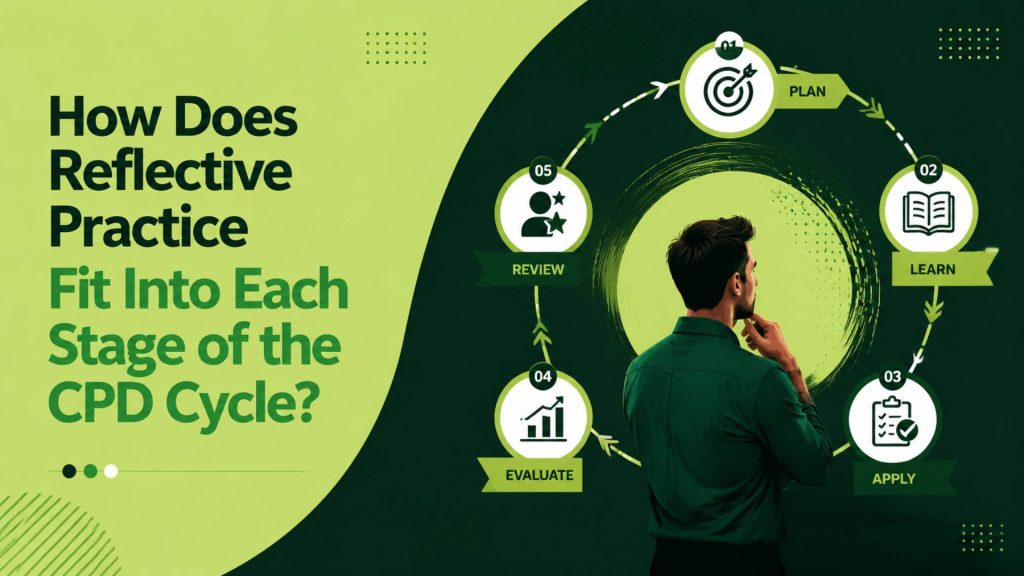
Reflection isn’t a single step at the end of a course — it belongs at three distinct points in the CPD cycle: before the activity (identifying the gap), during or immediately after it (processing the new learning), and well after it (assessing whether it changed your practice).
Before: identifying the learning need. Good CPD starts with a reflective question — “where is my knowledge weakest right now, and what’s the cost of leaving that gap?” This is what turns CPD from a generic checklist into targeted development, and it’s the reason CPD providers ask about learning outcomes and prior experience during course submission.
During and immediately after: consolidating the learning. This is the “so what” stage — the short written reflection CPDQE-aligned courses ask for, the self-assessment quiz, the debrief discussion. Immediately after a session is when reflection is most effective, because the material is still fresh and specific rather than a vague memory of “a useful course.”
Later: auditing real-world impact. Weeks or months after the course, effective reflective practice asks whether the change actually stuck. Did you use the new regulation, technique, or framework in practice? This later reflection is what feeds the re-evaluation and continuous improvement responsibilities that sit with providers post-certification — and it’s the strongest evidence a professional can offer that CPD wasn’t just a certificate exercise.

What Does Good Reflective Practice Actually Look Like?
Good reflective practice is specific, honest, and tied to action — not a generic paragraph praising the course. A strong reflective entry names the exact idea or skill gained, describes a real situation where it applies, and states a concrete next step.
Compare these two reflections from the same course on updated data protection regulations:
Weak: “The course on data protection was informative. I learned a lot about the new regulation and would recommend it to colleagues.”
Strong: “Before this course, I didn’t realise our current client consent forms don’t cover the updated retention requirements. Next week I’ll review our consent template with the compliance team and flag the gap before our Q3 audit.”
The second version does what a reflective statement is meant to do: it names a specific misconception that was corrected, and it commits to a specific action with a timeframe. That’s the level of detail that satisfies both a genuine learning need and, where required, an auditor or accrediting body.
A useful format to structure this:
- What I thought before: your prior understanding or assumption.
- What changed: the specific new knowledge or skill.
- Where it applies: a real task, client, or situation in your current role.
- What I’ll do next: one concrete action, ideally with a date attached.

How Can Training Providers Build Reflection Into Their CPD Courses?
Providers build reflection into a course by designing dedicated reflection points into the session structure, not by bolting a feedback form on at the end. This aligns directly with CPDQE’s instructional design standards, which call for content that connects to learners’ actual work environments so they can apply what they learn.
Practical ways to do this:
- – Add a short written reflection prompt at the end of each module, not just the whole course — this keeps the “so what” close to the “what happened.”
- – Use formative checks throughout, not only a final test — in-session quizzes and activities give learners (and providers) a running sense of what’s landing and what isn’t.
- – Ask application-specific questions rather than generic satisfaction ratings — “how will you use this next month?” produces far more useful data than “rate this course 1–5.”
- – Feed reflection data into course reviews — if reflections consistently show learners struggling to apply a particular module, that’s a direct signal for the periodic course review and audit process CPD frameworks require.
Frequently Asked Questions
Is reflective practice mandatory for CPD to count? It depends on the scheme, but most modern CPD frameworks — including CPDQE-aligned certification — treat reflection as a core validation mechanism, not an optional extra. Some professional regulators require a written reflective log as part of revalidation; others treat it as best practice that strengthens your CPD record even where it isn’t formally mandated.
How long should a CPD reflection be? There’s no universal rule, but useful reflections are usually short — a few sentences to a paragraph per learning point — and specific rather than long and vague. Depth of detail matters more than length.
What’s the difference between CPD hours and CPD reflection? CPD hours measure time spent on an activity; reflection measures what you took from it. A course log tells an assessor you attended; a reflective statement tells them what you actually understood and how you’re applying it — which is the evidence most audits and appraisals actually want to see.

Jordan Henderson is a well-known writer and CPD research analyst with extensive experience creating insightful content on professional development, workplace learning, leadership, compliance, and skills development.
Teaching is one of the most demanding professions in the world. Every day, educators stand in front of classrooms full of young people who need not just information but inspiration, guidance, and the kind of nuanced human understanding that no textbook can fully capture. The world those students are growing into changes faster than any curriculum can keep pace with. And the teachers who serve them best are not the ones who stopped learning the day they qualified — they are the ones who never stopped.
That commitment to ongoing learning has a name: Continuing Professional Development, or CPD. For teachers, CPD is not a bureaucratic obligation or an annual form to fill in. At its best, it is the engine that keeps great educators growing, adapting, and bringing fresh energy and insight into their classrooms year after year. It is the difference between a teacher who is merely experienced and one who is genuinely excellent.
But CPD for teachers is not a single thing. It is a broad, rich landscape of different formats, approaches, and opportunities — from formal accredited courses and school-based INSET days to peer coaching, action research, online webinars, and professional learning communities. Understanding the full range of what is available is the first step toward using CPD well rather than simply completing it.
This blog explores every major type of CPD available to teachers — what each one looks like in practice, what it offers, and when it works best. Whether you are a newly qualified teacher building your first professional development portfolio or an experienced educator looking to reinvigorate your practice, this guide is for you.
Why CPD Matters Specifically for Teachers
Professional development matters in every field, but it carries a particular weight in teaching. The reason is simple: when a teacher grows, so do their students. The quality of teaching is consistently identified in education research as the single most significant in-school factor affecting student outcomes. A teacher who is continuously developing their practice — who stays current with pedagogical research, refines their approaches, and deepens their subject knowledge — delivers a measurably better education to every student they teach.
The landscape of education itself demands it. Curriculum frameworks evolve. Examination systems are reformed. Technology reshapes how students learn and how teachers teach. Student needs become more complex, with growing awareness of mental health, neurodiversity, and the particular challenges facing young people today. A teacher who qualified a decade ago and has not actively engaged with CPD since then is, in a very real sense, operating with an outdated toolkit in a changed environment.
There is also the matter of professional registration and compliance. In many countries, teachers are required to complete a defined amount of CPD each year to maintain their teaching licence or registration. In England, for example, teachers are expected to demonstrate ongoing professional development as part of their career progression. In other jurisdictions, similar requirements exist under different names and frameworks. CPD is not optional for teachers — it is a professional and, in many cases, a regulatory expectation.
But beyond compliance, the teachers who engage most deeply with CPD are the ones who find it genuinely energising. Learning something new about how students process information, discovering a teaching approach that finally cracks a concept that students have always struggled with, or connecting with a community of educators who are grappling with the same challenges — these are the experiences that remind teachers why they entered the profession in the first place.
7 Core Types of CPD for Teachers
Before diving into the newer and more specialised formats, it is worth grounding ourselves in the types of CPD that have formed the foundation of teacher professional development for decades. These are the formats that most professional bodies and school systems recognise, that regulatory frameworks are built around, and that the majority of teachers will encounter at some point in their careers — regardless of their phase, subject, or years of experience.
They are not outdated. In fact, they remain some of the most effective and widely respected forms of development available to educators. Whether you are just starting to build your CPD portfolio or looking to bring more structure to an existing one, understanding these core types is where every teacher’s professional development journey should begin.
1. Formal CPD — Courses, Qualifications and Accredited Programmes
Formal CPD is the most structured and widely recognised type of professional development. It encompasses any learning that is delivered by a recognised provider, has defined objectives and learning outcomes, and results in some form of certification or documented evidence of completion. For teachers, formal CPD includes accredited short courses, postgraduate qualifications, subject-specific certification programmes, and structured training delivered by local authorities, teaching schools, or specialist educational organisations.
The value of formal CPD for teachers lies in its rigour and verifiability. When a teacher completes an accredited programme, they can demonstrate to their school, their governing body, and any future employer that their learning has been held to an externally assessed standard. This matters particularly for career progression — for teachers moving into leadership roles, specialist positions, or new phases of education, formal CPD provides the documented evidence of development that supports those transitions.
Formal CPD also tends to be where the most significant subject knowledge development happens. A secondary teacher who completes a subject-specific postgraduate module, or a primary teacher who undertakes an accredited programme in early reading or mathematics mastery, gains a depth of knowledge that informal learning rarely produces. The sustained, structured nature of formal programmes creates the conditions for genuine expertise to develop, not just awareness.
The main challenges with formal CPD for teachers are time and cost. School timetables are demanding, and accessing formal programmes often requires cover to be arranged, funding to be secured, and significant personal time to be committed. Despite this, many schools and local authorities offer bursaries, funding streams, or protected time to support teachers in accessing formal development — and those resources are worth actively seeking out.
2. INSET Days — In-Service Training
INSET — In-Service Education and Training — days are one of the most familiar forms of CPD in the teaching profession, particularly in the United Kingdom. These are designated days, typically at the start or end of a term, where students are not in school and the entire staff body engages in professional development together. In England, these have historically been known as ‘Baker Days’, named after the Education Reform Act of 1988 that introduced them.
At their best, INSET days are powerful opportunities for whole-school development. When they are well-designed, focused on classroom practice, and connected to the genuine development needs of teachers rather than administrative priorities, they can shift culture, introduce new approaches, and create shared professional language across a school community. The collective nature of INSET — the fact that everyone is learning together — can build cohesion and a shared sense of direction that individual CPD cannot replicate.
At their worst, however, INSET days can feel like a poor use of teachers’ professional time. Research from TeacherTapp’s 2024 State of CPD report found that INSET sessions frequently focus on school policies, compliance, and planning rather than on the instructional practice that teachers most want and need to develop. Fewer than two thirds of teachers reported that INSET days at the start of the year involved professional development in any meaningful form. Secondary schools showed a particularly marked absence of subject-specific development, with data analysis and target-setting often dominating the agenda instead.
The lesson for school leaders is clear: INSET days need to be designed with teachers’ actual development needs at the centre, not as a convenient slot for institutional communication. When they are, they are genuinely valuable. When they are not, they represent a significant missed opportunity — and teachers know the difference.
3. Peer Coaching and Mentoring
Of all the CPD types available to teachers, peer coaching and mentoring consistently emerge from research as among the most impactful. The reason is not complicated: learning from a colleague who shares your professional context, understands the specific challenges of your school and students, and can offer feedback grounded in direct observation is a fundamentally different — and often far more applicable — experience than learning from an external course or training provider.
Peer coaching involves two teachers working together in a structured, reciprocal relationship focused on developing their practice. It might involve one teacher observing another’s lesson and then engaging in a structured reflective conversation about what was observed. It might involve shared lesson planning, where both teachers bring their expertise to the design of a unit and then compare what happened when they delivered it. It might involve what some schools call ‘coaching triads’ — small groups of three teachers who meet regularly to discuss their practice, share evidence from their classrooms, and challenge each other’s thinking constructively.
Mentoring, while related, tends to be more directional — typically involving a more experienced teacher supporting the development of a newer or less experienced one. For newly qualified teachers (NQTs) and early career teachers (ECTs), mentoring is often a formal requirement, with designated mentors responsible for supporting their professional growth during the induction period. But mentoring is valuable beyond the early career stage too.
Teachers who are moving into new roles, taking on new subjects, or navigating significant changes in their practice benefit enormously from a trusted, experienced colleague who can offer guidance and perspective.
Both coaching and mentoring work best when they are embedded in a culture of psychological safety — where teachers feel comfortable being observed, sharing their uncertainties, and receiving honest feedback without fear of judgement. Building that culture is a leadership responsibility, and schools that invest in it tend to see significantly stronger CPD outcomes as a result.
4. Classroom Observation and Lesson Study
Watching other teachers teach — and being watched — is one of the oldest and most direct forms of professional development in education. Classroom observation, when done well, provides teachers with a direct window into pedagogy in practice: not theory described in a workshop but real teaching happening in a real classroom with real students.
There are different models of classroom observation. Traditional performance observation — where a senior leader watches a lesson and provides evaluative feedback — has its place, particularly in quality assurance and performance management contexts.
But research consistently suggests that the most developmentally valuable form of observation is peer observation, where teachers watch each other’s lessons with a specific, jointly agreed focus and then engage in a structured reflective conversation afterward. The evaluative power dynamic is removed, and the focus shifts entirely to learning.
Lesson Study is a more formalised and increasingly popular model of observation-based CPD, originating from Japan but now widely adopted in schools across the UK, US, and beyond. In Lesson Study, a small group of teachers collaboratively plan a ‘research lesson’ designed to address a specific teaching and learning challenge. One teacher delivers the lesson while the others observe — focusing not on the teacher’s performance but on the students’ learning responses. The group then meets to analyse what they observed, refine their understanding, and often re-teach the lesson with adjustments. The cycle produces genuine pedagogical insight that would be very hard to generate any other way.
The Learning Walk is a lighter-touch variation — a structured, collegial tour of classrooms across a school, focused on a specific agreed theme. Rather than a full lesson observation, a Learning Walk involves brief visits to multiple classrooms to observe how a particular aspect of practice is being enacted across the school. It is less intensive than formal observation or Lesson Study but provide valuable school-wide perspective.
5. Professional Learning Communities
A Professional Learning Community — or PLC — is a group of educators who meet regularly to share expertise, examine evidence, and work collaboratively to improve their practice and their students’ outcomes. The concept has been around in education for several decades, but its popularity has grown significantly as research has increasingly demonstrated the relationship between teacher collaboration and student achievement.
PLCs work on a simple but powerful premise: teachers learn best from each other, in sustained and structured ways, focused on real questions about real students. A well-functioning PLC does not just meet to share ideas — it examines student work, analyses assessment data, tests hypotheses about what is and is not working in the classroom, and holds itself collectively accountable for the learning outcomes of the students it serves.
Within a school, PLCs might be organised by subject department, by year group, or by a shared area of interest or challenge — all the teachers working with students with additional needs, for example, or all the teachers experimenting with a new pedagogical approach. Across schools, PLCs can connect educators from different institutions who share a subject specialism or a professional interest, creating a broader community of practice that enriches everyone’s perspective.
The digital age has extended the reach of PLCs enormously. Online communities of practice — through social media platforms, dedicated professional networks, and virtual forums — allow teachers to participate in learning communities that span regions, countries, and continents. A secondary music teacher in a small rural school who might feel professionally isolated in their immediate context can connect with hundreds of colleagues facing similar challenges through an online PLC, sharing resources, strategies, and support in ways that would simply not have been possible a generation ago.
6. Action Research
Action research is one of the most intellectually rigorous and professionally empowering forms of CPD available to teachers. It involves a teacher — or a group of teachers — systematically investigating a specific question or challenge in their own classroom or school context, collecting evidence, reflecting on what that evidence reveals, and using those insights to refine their practice. It is professional learning rooted entirely in the reality of the teacher’s own work, with students as the ultimate measure of success.
A teacher undertaking action research might ask: what happens to student engagement when I change the way I structure independent reading time? Or: does providing structured sentence frames before a written task improve the quality of writing for students who struggle with language? Or: how do my Year 9 students respond differently to formative feedback delivered verbally versus in writing? These are not abstract research questions. They are practical, classroom-rooted investigations whose answers will directly improve teaching and learning.
The process of action research — forming a question, designing a way to investigate it, collecting and analysing evidence, and reflecting on what you find — develops teachers’ capacity for evidence-informed practice in a way that attending a lecture or completing a module cannot. It makes teachers into researchers of their own practice, and that shift in perspective tends to persist long after any individual investigation is complete.
Many schools now support structured action research as part of their CPD framework, sometimes in partnership with universities or Teaching School Hubs. Some teachers formalise their action research into written accounts that contribute to the broader evidence base of the profession — an act of professional generosity that benefits colleagues well beyond their own school.
7. Self-Directed and Reflective CPD
Not all valuable teacher development happens in structured programmes or collaborative groups. Some of the most important professional growth occurs in the quiet, individual practice of reflection — the habit of stepping back from the busyness of teaching and thinking carefully about what is working, what is not, and why.
Reflective practice is a cornerstone of teacher CPD frameworks in many countries. It involves teachers regularly examining their own practice with an honest, enquiring eye — not to be self-critical, but to be self-aware. A reflective journal, maintained consistently over time, becomes a rich record of professional growth: the strategies that worked and those that did not, the moments of genuine connection with students and the moments of frustration, the questions that have evolved and the insights that have accumulated.
Self-directed CPD for teachers also includes reading professional and academic literature — journals, research summaries, books about pedagogy, leadership, or subject knowledge — and engaging with the ideas that educational thinkers and researchers are producing. Teachers who read widely tend to think more broadly, draw connections that others miss, and bring a more informed perspective to their practice. The Education Endowment Foundation, ResearchED, and a growing ecosystem of evidence-based educational resources make high-quality professional reading more accessible to teachers than ever before.
Writing is another underused but powerful form of self-directed CPD. Teachers who write about their practice — whether in a private journal, a professional blog, or a published article — deepen their own understanding in the process of articulating it. Explaining something clearly requires you to understand it fully, and the discipline of writing often surfaces insights that the busy flow of the school day does not allow space for.
6 Additional Types of CPD for Teachers
Most teachers are familiar with the traditional forms of CPD — formal courses, INSET days, peer observation, and reflective practice. But the world of professional development has evolved significantly, and so have the ways in which teachers can access, experience, and record their learning.
The types covered in this section go beyond the conventional and reflect how modern educators are actually developing their practice today — through digital platforms, specialist conferences, online communities, subject associations, and a growing range of flexible, accessible formats. Each of these represents a legitimate and increasingly valued form of CPD for teachers, and together they open up a much richer landscape of professional growth than any single format could provide.
1. Online CPD and E-Learning
Online CPD has transformed the professional development landscape for teachers — and not before time. The practical constraints that have historically limited teachers’ access to CPD — cost, geography, timetabling, cover arrangements — are significantly reduced when learning can be accessed from anywhere, at any time, on any device. For busy teachers juggling planning, marking, pastoral responsibilities, and everything else the job demands, the flexibility of online CPD is not a luxury. It is often the difference between development happening and not happening at all.
The TeacherTapp State of CPD report found that teachers have a strong preference for online CPD, particularly for its ability to fit around the realities of their professional and personal lives. Online courses, webinars, video lectures, and interactive modules allow teachers to engage with high-quality content at the time and pace that works for them — pausing, rewinding, and revisiting as needed in a way that a live training session simply cannot accommodate.
The range of online CPD available to teachers has expanded enormously. Subject associations run online professional development programmes. Universities offer postgraduate modules and CPD certificates entirely online. Specialist organisations provide evidence-based training in areas like reading instruction, assessment for learning, behaviour management, and educational technology. The challenge is no longer access — it is quality evaluation. Not all online CPD is equal, and teachers investing their development time in online content deserve assurance that what they are accessing meets a professional standard.
2. Subject Associations and Specialist Networks
One of the richest and most underutilised CPD resources available to teachers is their subject association. Every major curriculum subject in UK education — and many around the world — has an association that exists specifically to support teachers in developing their subject knowledge, pedagogy, and professional community. The National Association for the Teaching of English (NATE), the Association for Science Education (ASE), the Geographical Association, the Historical Association, the Mathematics Association — these organisations offer a depth of subject-specific expertise that generic whole-school CPD simply cannot match.
Subject association CPD comes in many forms: conferences, journals, online courses, resource libraries, regional networks, and specialist study groups. For secondary teachers working in subject departments, these associations provide connection to a national community of colleagues who share their specialism — a particularly valuable resource for teachers of minority subjects who might feel professionally isolated in their own schools.
Primary teachers benefit too, particularly from associations focused on core subjects like mathematics and literacy, where the depth of subject knowledge required to teach well is often underestimated and under-supported. The work of organisations like the National Centre for Excellence in the Teaching of Mathematics (NCETM), which offers structured subject knowledge development through its Mastery Specialist programmes, exemplifies what high-quality subject-specific CPD looks like for primary practitioners.
3. Educational Conferences and CPD Events
Attending a well-chosen educational conference is one of the most energising CPD experiences a teacher can have. Not because conferences are always perfectly organised or because every session is a revelation — but because being in a space with hundreds of other educators who are equally committed to their profession creates a kind of professional electricity that is very hard to manufacture any other way.
The teacher conference landscape has diversified significantly in recent years. ResearchED — a grassroots movement of teacher-led, evidence-informed conferences — has grown from a single event in London to a global series of one-day conferences where teachers and researchers share findings and ideas in accessible, practically focused sessions.
Diverse Educators, WomenEd, and other advocacy-focused organisations run conferences that combine professional development with community building. Subject associations host annual conferences that bring together specialists from across the country. And the growth of virtual conferences has made conference-based CPD accessible to teachers who cannot attend in person.
Educational conferences are also one of the best contexts for expanding your professional network. The connections made in a conference session, over lunch, or in the conversations that spill out into the car park afterward can lead to collaborations, mentoring relationships, and professional friendships that enrich a teacher’s career for years. CPD that builds community is some of the most durable and motivating development available.
4. Leadership Development and Career-Stage CPD
CPD for teachers is not one-size-fits-all, and the development needs of a newly qualified teacher are very different from those of an experienced classroom practitioner, a middle leader, or an aspiring headteacher. Recognising this, a range of CPD frameworks and programmes have been developed specifically to support teachers at different career stages.

For early career teachers, the Early Career Framework (ECF) in England provides a structured two-year induction programme backed by research evidence and delivered through a combination of mentoring, training, and independent study. Equivalent programmes exist in other jurisdictions under different names, but the underlying principle is the same: the first years of a teaching career are a critical period for professional formation, and structured support during this time significantly improves both teacher effectiveness and retention.
For teachers moving into middle leadership — as heads of department, year group leaders, or curriculum leads — programmes like the National Professional Qualification for Middle Leadership (NPQML) in England provide structured development focused on the specific competencies that leadership roles require. For aspiring headteachers, the National Professional Qualification for Headship (NPQH) provides a rigorous pathway of study, mentoring, and practical experience that prepares candidates for the demands of school leadership.
Beyond formal qualifications, leadership CPD also includes coaching for leaders, governance training, systems thinking, strategic planning, and the kind of sustained reflective practice that allows leaders to examine their own impact on the school culture and outcomes they are responsible for. The best school leaders are, in many ways, the best learners — and their CPD sets the tone for the development culture of the whole school.
5. EdTech and Digital Skills CPD
Technology has changed teaching — and teachers who do not engage with CPD in this area risk falling behind in ways that directly affect their students’ learning experience. EdTech CPD encompasses the full range of learning about how digital tools, platforms, and approaches can be used effectively — and critically evaluated — in the classroom.
This is not just about learning to use a specific platform or app. The most valuable EdTech CPD helps teachers develop a critical, pedagogically grounded approach to technology — understanding when and why digital tools enhance learning, and when they are a distraction or a shortcut that reduces rather than deepens understanding. Artificial intelligence is now adding a new and urgent dimension to this challenge, with AI tools being used by both teachers and students in ways that raise profound questions about pedagogy, assessment, integrity, and the fundamental purposes of education. CPD in this space is not optional — it is an increasingly pressing professional necessity.
Schools, local authorities, subject associations, and specialist EdTech organisations all offer CPD in this area, ranging from practical hands-on training with specific tools to deeper professional enquiry into the principles of effective technology integration. CPDQE Quality Ensured accreditation is particularly valuable in the EdTech CPD space, where the proliferation of provider-led training that is more promotional than educational makes independent quality assessment especially important.
6. Wellbeing and Pastoral CPD
Teaching is a profession with significant wellbeing challenges. Workload, emotional labour, the demands of pastoral responsibility, and the pressures of accountability all take their toll. CPD that supports teachers’ own wellbeing — and that develops their capacity to support the wellbeing of their students — is increasingly recognised as an essential component of a rounded professional development offer.
Wellbeing CPD for teachers covers a broad spectrum. It might include training in trauma-informed approaches to working with vulnerable students, mental health first aid certification, understanding and supporting students with special educational needs and disabilities (SEND), or developing the classroom management skills that reduce the emotional exhaustion that comes from consistently chaotic learning environments.
It also increasingly includes CPD focused on teacher wellbeing directly — building sustainable working habits, developing emotional regulation strategies, and creating the conditions for a teaching career that can be sustained with genuine engagement and satisfaction over decades rather than burning out in the first five years.
Schools that treat wellbeing CPD as a serious professional development priority — rather than a one-off session on a wellbeing INSET day — see the benefits in staff retention, engagement, and the quality of pastoral care that their students receive. The two are inseparable: teachers who are supported and well can support and teach their students far more effectively.
How to Build a CPD Plan That Works for Teachers
Understanding the types of CPD available is only the beginning. The teachers who get the most from professional development are the ones who approach it with intention — who connect their learning to specific goals, choose activities that genuinely address their development needs, and build habits of reflection that make every experience a source of professional growth.
Start with an honest self-assessment. Where are your genuine strengths as a teacher? Where do you feel least confident — in your subject knowledge, your pedagogical repertoire, your classroom management, your understanding of your students’ needs? What feedback have you received from observations, appraisals, or your own reflective practice that points to areas for development? This honest audit is the foundation of any CPD plan that will actually change your practice rather than simply adding activities to a portfolio.
Set goals that are specific and meaningful. Rather than ‘I want to improve my use of assessment’, try ‘I want to develop my use of formative assessment strategies in Year 9 science so that I can better identify and address misconceptions before they affect exam performance.’ That specificity makes it far easier to choose the right CPD activity, measure your progress, and reflect honestly on the impact.
Choose CPD that matches both your goals and your learning style. If you learn best through discussion and collaboration, a professional learning community or peer coaching relationship will serve you better than a solo online module. If you value depth and rigour, a formal course or action research project will be more developmental than a conference session. The best CPD is not the most prestigious or the most expensive — it is the type you will engage with fully and learn from genuinely.
Balance your CPD across types. A portfolio that is entirely formal and accredited may look impressive but misses the breadth that informal reading, reflective practice, and collegial learning provide. A portfolio that is all informal and self-directed may not meet professional registration requirements and may leave significant development needs unaddressed. Aim for a mix that reflects the full range of ways in which you actually grow as a professional.
And always reflect. Whatever CPD you complete — a conference, a course, a coaching conversation, or a quietly transformative podcast episode — take the time to write down what you took away and how you plan to apply it. That reflection is not an administrative formality. It is where the learning actually happens.
Final Thoughts
Teaching is a profession that demands continuous growth. The students in our classrooms deserve teachers who are not just experienced but genuinely excellent — who bring current knowledge, refined skills, and fresh perspectives to their practice every single day. CPD is how that standard of excellence is maintained and developed over the course of a career.
The landscape of CPD available to teachers has never been richer. From the rigour of formal accredited programmes and the depth of action research, to the accessibility of online learning and the community of professional learning networks, there is a form of professional development that works for every teacher — regardless of their subject, phase, career stage, budget, or schedule.
The teachers who make the most of it are not necessarily the ones who do the most. They are the ones who do it with intention — who know what they are trying to develop, choose their activities with care, reflect honestly on what they learn, and let their CPD actually change how they teach. That combination of curiosity, discipline, and genuine commitment to growth is what makes a great teacher — and it is what CPD, at its best, exists to support.
Jordan Henderson is a well-known writer and CPD research analyst with extensive experience creating insightful content on professional development, workplace learning, leadership, compliance, and skills development.