Jordan Henderson
06-11-2026
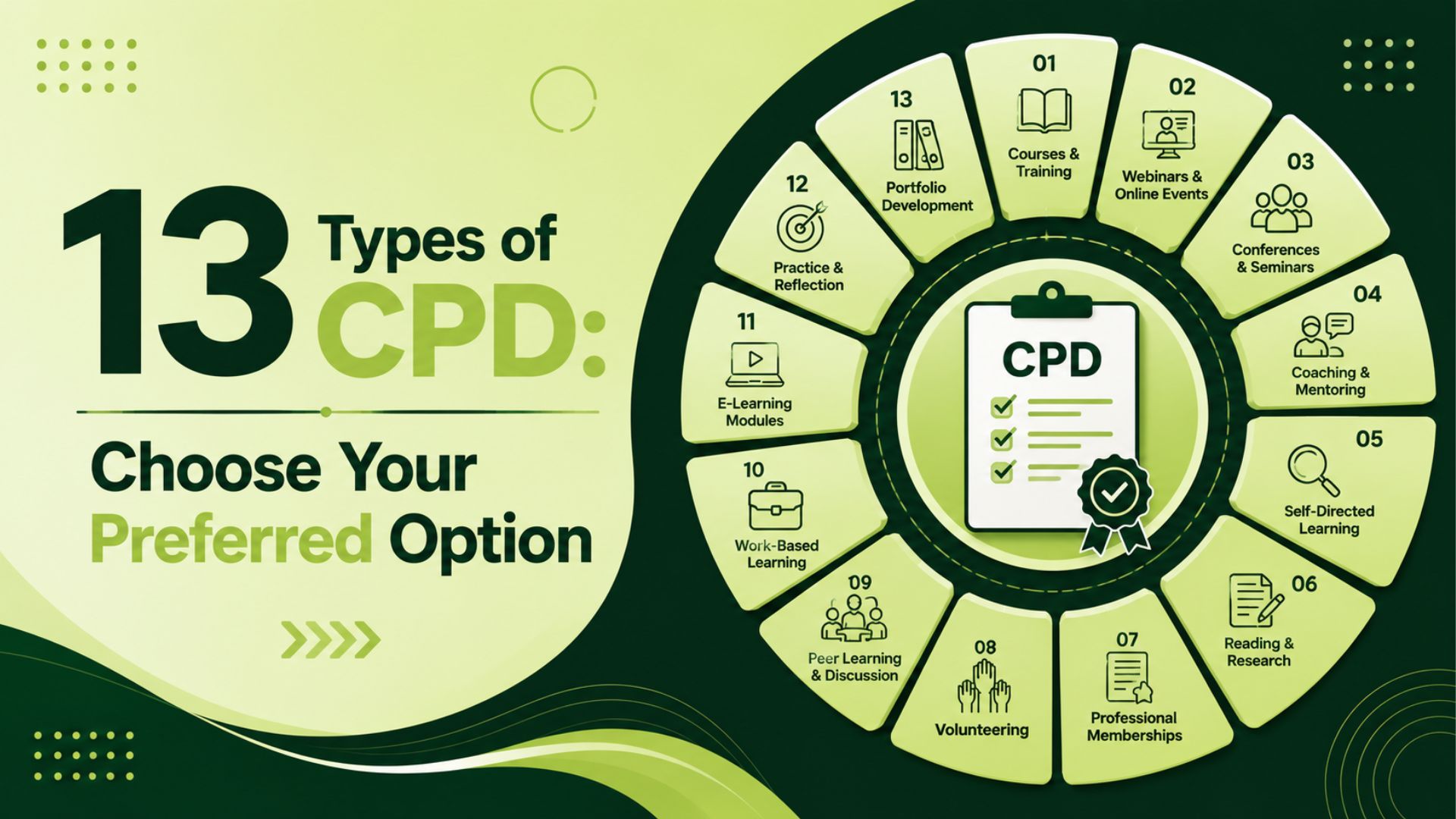
Here is something no one really tells you when you qualify for your profession: the learning does not stop. If anything, it speeds up. The world keeps moving, your industry keeps shifting, and the knowledge that got you through your exams will only carry you so far before it starts to feel dated.
That is what Continuing Professional Development — CPD — is all about. It is the ongoing commitment to keeping your skills sharp, your knowledge current, and your career moving forward. Most professionals have heard of it. Many dutifully complete it every year. But far fewer have stopped to ask: am I actually doing the right kind of CPD for where I am and where I want to go?
Because here is the thing — CPD is not one-size-fits-all. It comes in many different forms, and understanding all the types available to you is what separates the professionals who treat CPD as a checkbox exercise from those who use it as a genuine career tool.
This blog breaks down every major type of CPD, what it looks like in practice, and how to figure out which combination works best for you.
Think about how differently people learn. Some thrive in structured classroom settings with clear objectives and deadlines. Others absorb information best by reading quietly on their own. Some learn most effectively by doing — by rolling up their sleeves and taking on a challenge they have never faced before. There is no single correct way to grow professionally, and CPD reflects that reality.
Different industries also have different cultures and expectations around development. A surgeon’s CPD looks nothing like a graphic designer’s. A solicitor’s development requirements bear little resemblance to a software engineer’s. Some professions have rigid, mandatory frameworks that dictate exactly how many hours of learning you must complete and in what format. Others give you near-total freedom to design your own development journey.
This flexibility is one of CPD’s greatest strengths. But it also means that if you do not understand the landscape, you might end up investing your time and energy in the wrong places — completing activities that feel productive but do not actually move the needle. Knowing the different types of CPD available to you is the first step toward using it well.
Before diving into the newer and more specialised formats, it is worth grounding ourselves in the types of CPD that have formed the foundation of professional development for decades. These are the formats that most professional bodies recognise, that regulatory frameworks are built around, and that the majority of professionals will encounter at some point in their careers — regardless of their industry, seniority, or learning style. They are not outdated.
In fact, they remain some of the most effective and widely respected forms of development available. Whether you are just starting to build your CPD portfolio or looking to bring more structure to an existing one, understanding these core types is where every professional development journey should begin. Everything else — the newer formats, the digital tools, the emerging approaches — builds on this foundation.
When most people picture CPD, this is what comes to mind. Formal CPD is structured, planned, and usually delivered by a recognised training provider, professional body, or educational institution. It has a clear beginning and end, defined learning objectives, and — in most cases — some form of assessment or certification at the conclusion.
The most common examples of formal CPD include accredited courses and short programmes, professional certification exams, workshops and seminars run by industry bodies, postgraduate qualifications, and attendance at formal conferences where structured sessions are delivered by subject matter experts. These are the kinds of activities that come with a certificate you can add to your CPD portfolio and, in many cases, to your CV.
Formal CPD tends to carry the most weight in regulated professions — healthcare, law, finance, engineering — where professional bodies have strict requirements about what kinds of learning count toward annual obligations. The obvious advantages are credibility and verifiability. A formal qualification from a respected body signals to employers, clients, and regulators that your learning has been assessed against a defined standard.
The downsides are equally obvious: formal CPD tends to cost more, require more time, and follow a fixed schedule that may not always suit your workload. But for significant knowledge gaps or major career transitions, formal CPD is hard to beat.
Here is a type of CPD that most professionals are already doing — they just are not writing it down. Informal CPD encompasses all the everyday learning activities that sit outside of structured programmes but still contribute meaningfully to your professional knowledge and skills. Reading a trade journal on your lunch break. Listening to an industry podcast on your commute. Scanning a report published by your professional body. Watching a webinar someone shared in a LinkedIn post. All of this counts.
The reason informal CPD is so often underestimated is that it does not feel like learning in the traditional sense. There is no teacher, no syllabus, no end-of-course quiz. It is organic, self-paced, and woven into the fabric of professional life in a way that can make it almost invisible. But the cumulative effect of consistently engaging with your industry’s ideas, debates, and developments is enormous. Professionals who read widely and stay curious tend to think more broadly, spot opportunities others miss, and adapt more quickly to change.
The key to making informal CPD count is to treat it with a degree of intentionality. If you read a particularly insightful article, jot down the key points and note how they are relevant to your practice. It takes an extra two minutes, and it transforms a passive activity into something you can genuinely reflect on and learn from. Informal CPD is also the most accessible and affordable form of development available — much of it is free, and it fits around your schedule rather than demanding that your schedule fits around it.
Self-directed CPD takes informal learning a step further. Rather than passively consuming information, self-directed CPD involves actively taking ownership of your own development in a structured and reflective way — even if that structure is entirely self-imposed.
The most powerful tool in self-directed CPD is reflective practice. This is the habit of stepping back from your day-to-day work and thinking critically about what you are doing, how you are doing it, and what you could do differently. A reflective journal — even just a few lines written at the end of each week — can surface patterns in your work that are hard to see when you are in the middle of it. Over time, those reflections become a rich record of your professional growth.
Self-directed CPD also includes activities like conducting independent research into a topic that interests you, writing articles or blog posts about your area of expertise, participating in online communities where professionals exchange ideas, or teaching and explaining concepts to others — because nothing sharpens your own understanding quite like trying to make someone else understand something. Many professional bodies now actively encourage self-directed and reflective CPD, recognising that some of the most meaningful development happens not in a seminar room but in the quiet process of thinking carefully about your own practice.
If there is one type of CPD that has genuinely transformed the professional development landscape over the last decade, it is online learning. The explosion of e-learning platforms, virtual conferences, and digital content has made high-quality professional development more accessible than at any point in history — regardless of where you live, what hours you work, or how much you have to spend.
Online CPD covers an enormous range of formats. Massive Open Online Courses — better known as MOOCs — allow you to study structured programmes from universities and leading institutions around the world at your own pace, often for free or at very low cost. Platforms like Coursera, LinkedIn Learning, Udemy, and FutureLearn offer thousands of courses across virtually every professional discipline. Virtual conferences and online summits bring together speakers and delegates from around the globe without the cost and logistics of in-person events.
The advantages of online CPD are obvious: flexibility, affordability, and access. The main challenge is quality control. Not everything available online is well-produced or professionally rigorous. When choosing online CPD, it is worth checking whether the provider is accredited by a recognised body in your field. A well-chosen online course can be genuinely transformative. A poorly chosen one will just feel like time you could have spent better.
Some of the most impactful professional development you will ever experience will not happen in a classroom, on a screen, or in the pages of a journal. It will happen at your desk, in a meeting room, on a project that stretched you further than you thought you could go. On-the-job CPD — sometimes called experiential learning — is the development that comes directly from the work itself.
This might look like taking on a project outside your usual remit that forces you to develop new skills. It might be mentoring a more junior colleague — which, as anyone who has done it will tell you, teaches you at least as much as it teaches them.
It could be a job shadowing a colleague in a different department, joining a cross-functional team, leading a meeting for the first time, or simply volunteering for the task that everyone else is quietly hoping someone else will handle.
On-the-job CPD has one distinct advantage over every other type: immediate applicability. The skills and knowledge you gain through direct work experience are instantly relevant to the environment you are operating in.
There is no translation required between theory and practice — you are already in the practice. For many professionals, this makes experiential learning the most memorable and the most enduring form of development they engage in.
Most professionals are familiar with the traditional forms of CPD — formal courses, workplace learning, informal reading. But the world of professional development has evolved significantly, and so have the ways in which CPD can be experienced and recorded.
The types covered in this section go beyond the conventional and reflect how modern professionals actually learn today — through digital platforms, live events, audio content, video, and the people and organisations around them.
Each of these formats is a legitimate and valuable form of CPD in its own right, and together they represent the full, rich landscape of what ongoing professional development looks like in practice.
Whether you are a visual learner, an audio learner, someone who thrives in group settings, or someone who prefers self-paced digital content — there is a CPD format here that will work for you.
CPD courses are one of the most widely used and recognised formats in professional development. Unlike general online learning or casual reading, a CPD course is specifically designed to advance your professional knowledge or skills in a structured, measurable way. They range from short focused programmes that can be completed in a few hours to longer modular courses spread across weeks or months.
The distinction that matters most when choosing a CPD course is whether it is accredited. An accredited CPD course has been reviewed by an independent body and found to meet a defined quality standard — meaning the curriculum, delivery, and learning outcomes have all been assessed against professional benchmarks.
A non-accredited course may still contain valuable content, but it has not been held to that external standard, which matters both for your professional body’s requirements and for how employers will view it.
This is where CPDQE — CPD Quality Ensured — plays a significant role. CPD courses that carry the CPDQE Quality Ensured designation have been independently verified to meet rigorous standards of educational quality and professional relevance.
For professionals who want their course completion to carry genuine weight — with employers, with professional bodies, and in international contexts — choosing a CPDQE-accredited course is one of the smartest decisions they can make. Quality is not claimed by the course provider. It is ensured by the accreditor.
When selecting a CPD course, start with your development goals rather than with whatever is currently being promoted. The best course is the one that directly addresses a skill gap or knowledge area that is genuinely relevant to where you are and where you want to go — and that comes from a provider whose quality has been independently verified.
CPD events bring professionals together in a shared learning environment — and that shared dimension is something no individual course or online module can fully replicate.
Conferences, seminars, symposiums, networking summits, and professional forums all fall under the umbrella of CPD events, and they offer a kind of learning that is as much about the conversations in the corridors as it is about the sessions in the main hall.
The value of a CPD event goes beyond the content being presented. Being in a room — physical or virtual — with other professionals who are grappling with the same challenges, asking the same questions, and thinking about the future of your shared field creates a kind of professional energy that is hard to manufacture any other way. You hear perspectives you would not have encountered on your own. You discover that problems you thought were unique to your organisation are industry-wide. You leave with ideas, contacts, and a renewed sense of engagement with your profession.
In-person events offer the depth of connection that comes from face-to-face interaction. Virtual events offer access without the cost and logistics of travel — particularly valuable for professionals in locations where certain events would otherwise be out of reach.
CPDQE recognises the value of event-based learning and encourages professionals to log event attendance as part of a balanced CPD portfolio, provided the learning is genuinely relevant to their professional practice and properly reflected upon. We accredits the following CPD events– workshops, conferences, training days, industry summits, masterclasses, hybrid and virtual events.
To make the most of a CPD event, go with intention. Know which sessions are most relevant to your development goals, engage actively rather than passively attending, and set aside time afterward to record your key takeaways and how you plan to apply them. A CPD event only becomes CPD when the learning is captured and acted upon.
If CPD events are the conference hall, webinars are the seminar room — more focused, more accessible, and increasingly the format of choice for professionals who want structured learning without the commitment of a full course or the logistics of an in-person event. CPD webinars have grown enormously in popularity over the last decade, and for good reason.
A webinar delivers a defined learning session — typically between thirty minutes and two hours — in a format that can be attended live or accessed as a recording afterward. Live webinars offer the opportunity to ask questions, participate in polls, and interact with the presenter and other attendees in real time. Recorded webinars offer the flexibility of accessing the content when it suits you, pausing and rewinding as needed, and returning to key sections later.
The accessibility of webinars makes them particularly well-suited for busy professionals. You do not need to travel, rearrange your schedule significantly, or spend significant money. Many professional bodies and CPD providers offer free webinars to members or subscribers, making this one of the most cost-effective CPD formats available.
CPDQE-accredited webinar providers have had their content and delivery assessed against quality standards, giving professionals confidence that the learning they are accessing meets a recognised professional benchmark — not just in terms of what is being taught, but how well it is being taught.
To log a webinar as CPD effectively, record the title, provider, date, duration, and — crucially — a brief reflection on what you learned and how it connects to your professional practice. That reflection is what transforms an hour of passive watching into genuine professional development.
Podcasts have quietly become one of the most significant informal CPD formats of the modern professional era. They are available on demand, require no screen time, and fit into parts of the day — commutes, exercise, household tasks — that would otherwise be professionally unproductive.
For many professionals, podcast listening is already a daily habit. The question is simply whether that habit is being applied intentionally and recorded as CPD.
Audio podcasts work particularly well for professionals who absorb information best through listening, who have limited screen time during the day, or who want to maintain a steady flow of professional ideas and perspectives without carving out dedicated study time. A well-produced professional podcast — hosted by credible voices in your field, covering topics that are directly relevant to your practice — is a genuine source of professional development, not a lesser substitute for it.
The key to turning podcast listening into meaningful CPD is intentionality. Choosing podcasts with purpose — seeking out programmes that engage with current debates, interview industry leaders, or explore developments in your specific field — is very different from casually listening to whatever appears in your feed.
After a particularly valuable episode, take a few minutes to note the key ideas and how they relate to your work. That simple step elevates listening from a passive activity into an active one. CPD Audio podcast encourages professionals to include audio-based learning in their CPD portfolios, recognising it as a legitimate and increasingly valuable format for ongoing professional development.
Video podcasts — sometimes called vodcasts — take the audio podcast format and add a visual dimension that opens up new possibilities for professional learning. Demonstrations, presentations, panel discussions, and interviews all benefit from the added layer of visual context that video provides.
Watching an expert walk through a complex process, seeing the non-verbal dynamics of a professional conversation, or following a slide-based explanation alongside the audio — these elements add depth that audio alone cannot deliver.
Platforms like YouTube have become significant repositories of professional learning content, hosting everything from lecture series delivered by university academics to practitioner-led discussions about real-world challenges in specific industries. The range and accessibility of this content has made video podcasting one of the fastest-growing CPD formats across virtually every professional sector.
The distinction between professional development content and general entertainment content is an important one on video platforms. Not everything that appears in a search result for your professional field will be rigorous, current, or accurate.
The same quality evaluation that applies to any CPD activity applies here: consider the credentials of the presenter, the relevance and currency of the content, and whether the provider has any form of accreditation or professional body endorsement.
CPDQE’s Quality Ensured standard is increasingly being applied to digital content providers, helping professionals identify video-based learning that meets a verified quality benchmark rather than relying solely on view counts or production values.
Edutorials are an emerging and increasingly popular CPD format that sits at the intersection of education and tutorial-based learning. Unlike a standard tutorial — which typically focuses on how to perform a specific task — a CPD edutorial is designed to develop professional understanding as well as practical skill. It combines instructional content with contextual explanation, helping the learner not just to do something but to understand why it matters and how it connects to broader professional practice.
In practical terms, an edutorial might walk a healthcare professional through a new clinical procedure while explaining the evidence base behind it. It might guide a finance professional through a regulatory update while explaining the reasoning and implications of the change. It might take a project manager through a new methodology while situating it within the wider landscape of project management thinking. The educational depth is what distinguishes an edutorial from a simple how-to video.
Edutorials are particularly well-suited to practical, skill-based professions where the gap between understanding a concept and being able to apply it is significant. They bridge that gap in a format that is engaging, accessible, and — when produced by a quality provider — genuinely developmental. CPDQE’s Quality Ensured accreditation is especially relevant here, as it assesses not just the accuracy of the content but the educational design of the learning experience — ensuring that edutorials actually develop professional competence rather than simply demonstrating a process.
For your CPD portfolio, edutorials should be logged in the same way as any other learning activity: with a note of the provider, the topic covered, the time invested, and a reflection on how the learning applies to your practice.
The relationship between employers and CPD is one of the most underexplored dimensions of professional development — and one of the most important. An employer’s attitude toward CPD shapes the development culture of an entire organisation, which in turn shapes the growth trajectories of every professional within it.
Forward-thinking employers do not treat CPD as an employee’s private responsibility that sits outside of working hours. They recognise that a workforce that keeps learning is a workforce that keeps performing — and they structure their organisations accordingly. This might mean dedicated CPD budgets that employees can draw on to fund courses, events, and other development activities. It might mean protected time during the working week for learning and reflection. It might mean internal mentoring programmes, structured learning pathways, or partnerships with accredited training providers to deliver CPD directly to their teams.
CPDQE works with employers to ensure that the CPD they provide or fund meets the Quality Ensured standard. When an employer commissions or delivers CPD training that carries CPDQE accreditation, their employees can be confident that the learning they are receiving has been independently assessed for quality — and that the certificates they earn will carry genuine weight with professional bodies and future employers. For organisations that want to demonstrate a genuine commitment to professional development, partnering with CPDQE-accredited providers is one of the most credible ways to do so.
As an employee, it is entirely reasonable to ask your employer what CPD support is available to you and how they approach professional development across the organisation. The most progressive employers see this conversation as a sign of professional ambition — exactly the quality they want to nurture in their people.
Behind every great CPD programme is a great CPD trainer. The trainer is the human element that determines whether a learning experience is genuinely transformative or merely informative — and the difference between those two outcomes is enormous. A skilled CPD trainer does not just deliver content. They create the conditions in which real learning happens: drawing on participants’ existing knowledge and experience, making complex ideas accessible, challenging assumptions, and connecting abstract concepts to practical reality.
Not everyone who delivers training is a CPD trainer in the fullest sense. The title implies a specific commitment to professional development — an understanding of how adults learn, how professional competence develops, and how learning needs to be structured and delivered to produce lasting change in knowledge, skill, and practice. A CPD trainer brings subject matter expertise together with pedagogical skill — and that combination is what produces development rather than just information transfer.
CPDQE accreditation for trainers is a meaningful quality signal for professionals and organisations choosing who to learn from. A CPDQE Quality Ensured trainer has been assessed not just on their knowledge of their subject but on their ability to deliver that knowledge in a way that meets rigorous educational standards. Their delivery methods, their materials, and their approach to learner outcomes have all been evaluated against the Quality Ensured benchmark. For professionals investing their development time in a trainer-led programme, that assurance matters — it means the person at the front of the room has been independently verified as someone worth learning from.
When choosing a CPD trainer, look beyond the biography and the testimonials. Ask whether they hold any accreditation from a recognised body, whether their programmes are independently assessed for quality, and whether the learning they offer is aligned with the standards your professional body requires. The best trainers will welcome those questions.
Many professional bodies draw a distinction between structured and unstructured CPD, and it is a useful framework for thinking about the balance of your own development activity.
Structured CPD refers to learning that is planned in advance, has clear objectives, and produces a measurable outcome. Attending a workshop with a specific learning goal in mind, completing an online course with defined modules and assessments, or participating in a formal mentoring programme with agreed objectives — all of these are structured. You knew what you were going to learn before you started, and you can point to something concrete at the end.
Unstructured CPD, on the other hand, is more organic. It includes reflective practice, informal reading, general professional conversations, and the kind of incidental learning that happens naturally in the course of doing your job. It is less predictable and harder to quantify, but it is no less real. A balanced CPD portfolio typically includes both. Structured activities provide direction and depth. Unstructured activities provide breadth and adaptability. Leaning too heavily on one at the expense of the other tends to produce a development record that either feels rigid and narrow or vague and hard to defend when a professional body comes calling.
In many regulated professions, some CPD is not optional. It is a condition of maintaining your professional registration, your practising licence, or your membership of a professional body. This is mandatory CPD — the baseline minimum that your profession requires you to complete, usually within a defined period, and often in specific formats or subject areas.
Mandatory CPD requirements vary enormously. A doctor might be required to demonstrate competence across a range of clinical and non-clinical domains. A solicitor might need to complete a prescribed number of hours in ethics and professional conduct. An accountant might be required to keep up to date with changes to financial reporting standards. Whatever the specific requirements in your field, mandatory CPD sets the floor — the minimum level of engagement your profession has collectively decided is necessary to practise safely and competently.
Voluntary CPD is everything you do above and beyond that minimum. It is the extra course you take because a topic genuinely interests you. The conference you attend because you want to meet people doing innovative things in your field. The podcast you listen to because a colleague recommended it. Voluntary CPD is where the most ambitious and curious professionals really distinguish themselves — not because it looks good on paper, but because it reflects a genuine commitment to excellence that tends to show up in the quality of their work. The professionals who do only the minimum are, by definition, keeping pace. The ones who go beyond it are the ones who get ahead.
One of the most important questions a professional can ask about any CPD activity is not just ‘did I learn something?’ but ‘was this learning good enough?’ That is the question CPDQE — CPD Quality Ensured — exists to answer.
Across every type of CPD covered in this blog — from formal courses and workplace learning to webinars, podcasts, edutorials, and trainer-led programmes — the CPDQE Quality Ensured standard provides an independent, externally verified benchmark of educational quality. It means that a recognised body has assessed the learning experience and found it to meet rigorous standards of curriculum design, delivery, learning outcomes, and professional relevance. Quality is not self-declared by the provider. It is ensured by an independent accreditor.
For professionals, this matters in practical, career-defining ways. A CPD portfolio built from CPDQE Quality Ensured activities carries more credibility with professional bodies, more weight with employers, and more portability across international borders than one built from unverified sources. When you invest your development time, you deserve to know that the learning you are committing to has been held to a standard — not just by the person selling it to you, but by an independent body whose entire purpose is to ensure that standard is real.
For employers and training providers, CPDQE accreditation is a signal to the market that the development they are commissioning, delivering, or funding meets a quality benchmark that professionals and regulatory bodies can trust. It is a commitment to doing CPD properly — not as a box-ticking exercise, but as genuine investment in the growth of the professionals who depend on it.
Whether you are a professional building your CPD portfolio, an employer developing your team, or a trainer delivering programmes to others — CPDQE Quality Ensured is the standard that ensures your CPD investment is worth making.
With so many types of CPD available, it can be genuinely hard to know where to start. A few practical principles can help you make better choices and get more from every development activity you undertake.
Start with your goals, not with a list of available courses. What do you actually want to be better at? Where do you feel least confident in your current role? What skills would make the biggest difference to your career in the next twelve months? Your answers to those questions should drive your CPD choices far more than whatever happens to be on offer from a training provider this month.
Be honest about how you learn. If you know that you struggle to sit through long online courses, booking ten hours of e-learning is probably not going to go well. If you absorb information best through conversation, a mentoring relationship or CPD event might serve you far better than reading journals. The best type of CPD is the type you will actually engage with fully — not the type that looks most impressive on a log.
Think about balance. A CPD portfolio that consists entirely of formal, accredited courses might look thorough on paper, but it misses the richness that comes from mixing in reflective practice, informal reading, podcasts, webinars, and workplace learning. Aim for a mix that reflects the full range of ways in which you actually grow. And wherever possible, prioritise CPDQE Quality Ensured activities — because the quality of your CPD matters as much as the quantity.
Finally, review what you are doing regularly. CPD is not something to plan once at the start of the year and then execute on autopilot. As your role evolves, as your industry changes, and as you achieve some goals and discover new ones, your CPD priorities will shift. The professionals who get the most from CPD are the ones who treat it as a living, responsive practice rather than a static annual obligation.
CPD is not a single thing. It never was. It is a whole family of different approaches to professional learning — some formal and structured, some informal and organic, some happening in training rooms and some happening through a podcast on a morning commute. Understanding the full range of what counts as CPD is genuinely liberating, because it means that almost every professional, regardless of their schedule, budget, or learning style, can find a way to engage with their own development in a way that feels meaningful and works for them.
The professionals who thrive long-term are rarely the ones who have attended the most courses or collected the most certificates. They are the ones who have stayed genuinely curious — who kept asking questions, kept seeking out new ideas, and kept reflecting honestly on their own practice. That is what CPD, at its best, enables. Not compliance. Not box-ticking. Real, sustained, career-long growth.
And when that growth is backed by CPDQE Quality Ensured accreditation — when the learning you invest in has been independently verified to meet a recognised standard of quality — you can be confident that every hour you spend developing yourself is an hour genuinely well spent.

Jordan Henderson is a well-known writer and CPD research analyst with extensive experience creating insightful content on professional development, workplace learning, leadership, compliance, and skills development.