Would you know what to do in the first sixty seconds if a colleague collapsed, a child started choking, or someone near you stopped breathing? Most people freeze, not through lack of care, but because nobody has ever shown them what to do.
The good news is that you can build that confidence without leaving your desk. The best CPD first aid courses right now combine three things: a real practical demonstration video so you can see the technique, not just read about it, genuine CPD certification you can log against your professional development record, and content that maps onto real emergencies rather than generic theory.
For most people looking for an accredited, free, video-led option, the Be Ready in an Emergency: First Aid Awareness Webinar, powered by CPDQE is the strongest all-round choice, because it’s free, online, CPD certified, and covers both adult and paediatric first aid in one session. But it isn’t the only option worth knowing about. Below, we compare it against the free British Red Cross workshops and a paid, HSE-aligned classroom qualification from Leeds Beckett University, so you can pick the right course for your situation.
What Makes a First Aid Course Actually Worth Your Time?
A first aid course is worth taking if it teaches you a physical skill you can demonstrate, not just a fact you can recite. Look for three things: video or live practical demonstration, a recognised certificate you can point to, and coverage of the emergencies you’re actually likely to encounter.
Watching someone perform CPR, treat a burn, or manage a choking child is a completely different learning experience to reading a bullet-point list. Video demonstration lets you pause, rewind, and mimic hand placement and rhythm in a way that text never can. That’s why every course we’ve shortlisted below includes a practical, visual teaching element rather than slides alone.
Certification matters too. A CPD certificate gives you evidence of learning you can log for professional development, show to an employer, or add to a CV. A workplace first aid qualification, on the other hand, satisfies a legal requirement rather than a CPD one, and the two aren’t interchangeable, so it’s worth being clear on which one you actually need before you book.
Which First Aid Courses Are Completely Free to Book?
The British Red Cross offers two free, non-accredited options: self-directed online first aid skills training you can work through at your own pace, and a live, instructor-led 90-minute first aid workshop for adults delivered on Microsoft Teams or face to face.
The self-paced online pages let you learn CPR, choking response, and wound care through short videos and a free companion app, at zero cost and with no booking needed. It’s a genuinely useful starting point if you just want to build baseline confidence.
The live workshop goes further, with an experienced Red Cross educator taking you through hands-on techniques for CPR, bleeding, burns, and stabilising injuries using everyday household objects. It’s worth knowing this workshop has eligibility limits: it’s aimed at community members and non-profit organisations, not paid staff, individual parents, or anyone specifically seeking baby and child first aid, and group bookings need between 5 and 15 people. It’s also a workshop of learning rather than a formal qualification, so you’ll get a self-completed certificate of learning rather than CPD points or a legally recognised certificate. If you fall outside that eligibility window, the Red Cross points you toward its accredited Red Cross Training courses instead.
What’s the Best Paid, Workplace-Compliant First Aid Course?
If you need a legally recognised qualification for your workplace, Leeds Beckett University’s First Aid at Work with AED (three days) is the strongest paid option, priced at £269 with sessions running throughout 2026 at its Headingley Campus in Leeds.
This is a competency-based course built to the standards required by UK health and safety law, with First Aid Industry Body (FAIB) approval and built-in Automated External Defibrillator (AED) training in line with British Heart Foundation recommendations. Candidates practise CPR, choking response, wound and bleeding management, and how to respond to conditions like anaphylactic shock, seizures, strokes, and suspected spinal injuries, then sit a practical assessment before receiving a First Aid at Work certificate valid for three years.
This is the right choice if your employer needs a nominated, qualified first aider on site rather than a general awareness certificate. It’s a three-day, in-person commitment though, so if you just want CPD-recognised awareness training you can complete online in an hour or two, one of the options below will suit you better.
Which Online CPD First Aid Course Offers the Best Overall Value?
For most people who want free, online, CPD-certified training with a genuine practical demonstration, the Be Ready in an Emergency webinar powered by CPDQE is the best overall pick. It runs on Thursday 16 July 2026 from 5:00pm to 6:30pm UK time, entirely online, and is completely free to attend.
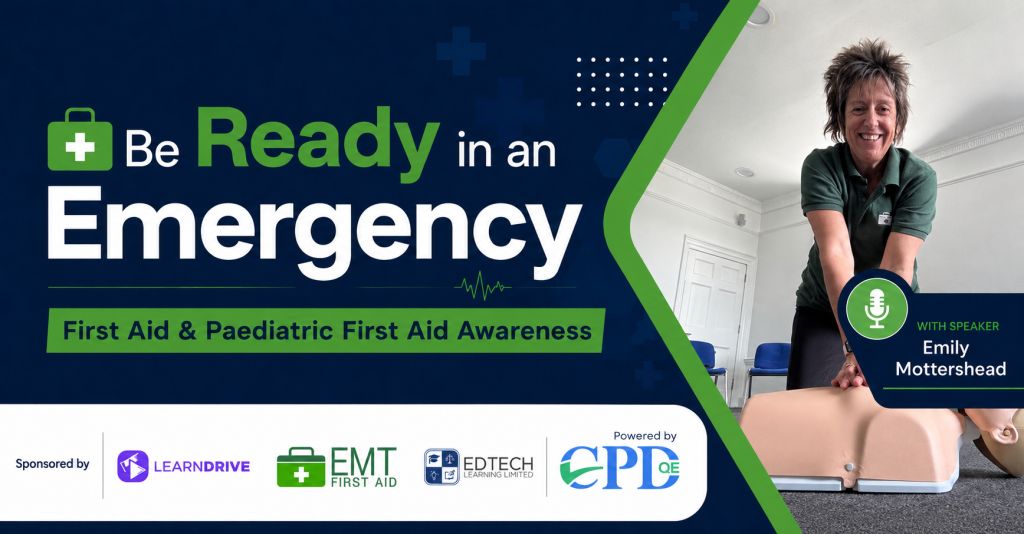
The session is led by Emily Mottershead and introduces the essential principles of both First Aid and Paediatric First Aid in a single, practical webinar.
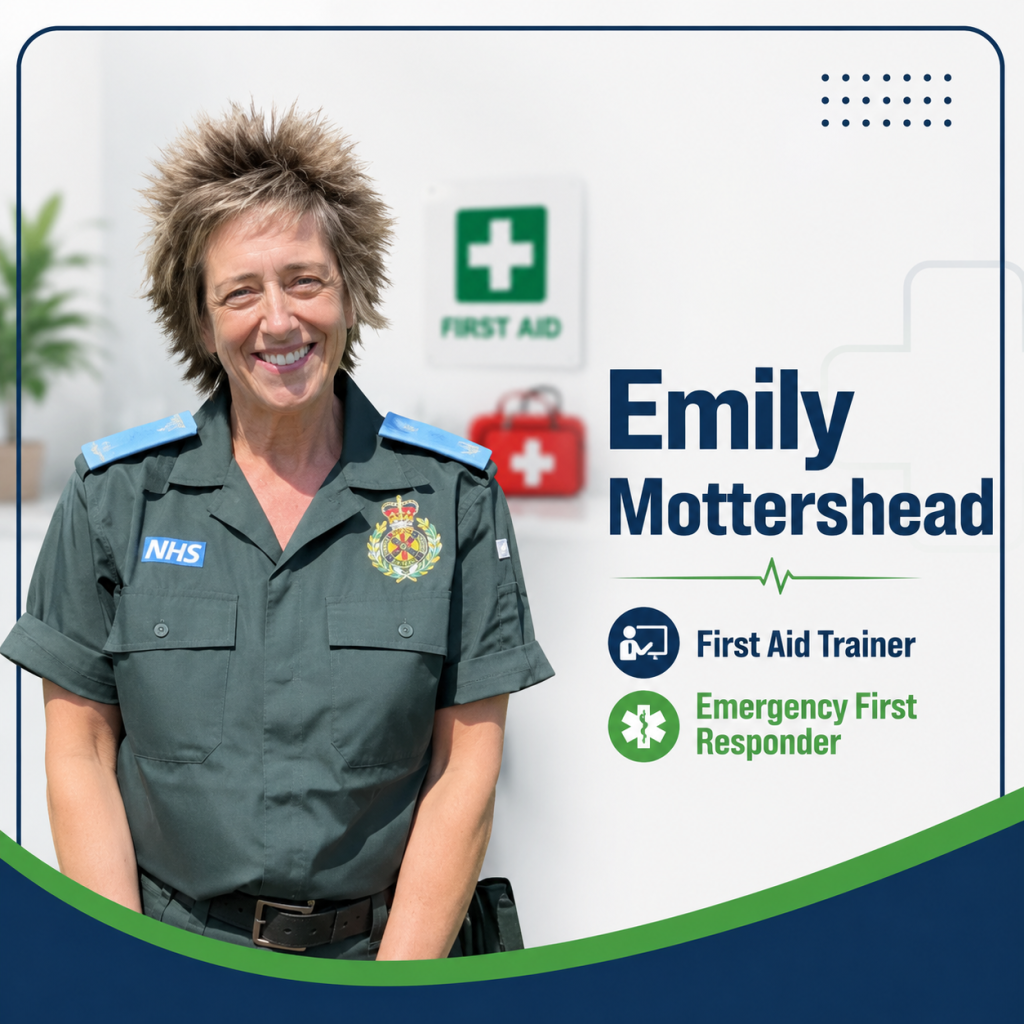
That combination matters, because most free community workshops only cover adult scenarios, while dedicated paediatric courses are usually paid. Covering a choking toddler, a colleague collapsing at their desk, and a child having an asthma attack in the same session means you leave with a broader, more useful skill set than a single-topic course provides.
Unlike the Red Cross community workshop, this webinar is open to a general audience rather than restricted to non-profit groups, and it’s CPD certified through CPDQE, so you can log the hour against your professional development record and order a certificate afterwards. If you only book one course from this list, this is the one that gives you the widest coverage for zero cost.
What Should a Good CPD First Aid Course Actually Cover?
A comprehensive CPD first aid course should cover CPR, choking, burns, bleeding, drowning, seizures, heatstroke, and the effects of intoxicants, alongside the practical basics of infection control, incident management, and the recovery position.
Beyond the technical skills, a genuinely useful course also teaches you how to assess a scene safely, recognise when someone is unconscious or has stopped breathing, and prioritise care until professional help arrives. If you’re comparing two courses and one only ticks off CPR while the other works through this fuller list, the broader course will serve you better in a real emergency, since you rarely get to choose which type of incident you’re first on the scene for.
What Does UK Law Actually Require for Workplace First Aid?
Under the Health and Safety (First-Aid) Regulations 1981, UK employers must provide adequate and appropriate first aid equipment, facilities, and trained personnel so that employees receive immediate attention if they’re injured or fall ill at work. The exact level of provision depends on a first aid needs assessment specific to that workplace.
These regulations, set out in full on legislation.gov.uk, don’t legally require employers to provide first aid for non-employees such as visitors or members of the public, though the Health and Safety Executive recommends including them in the needs assessment anyway. This is the key distinction to understand before you book a course: if your employer needs you to be their designated, legally compliant first aider, you need a workplace qualification like the Leeds Beckett course above, not a CPD awareness webinar. If you simply want the skills and confidence for yourself, your family, or general professional development, a CPD-certified awareness course covers what you need.
How Much Difference Does Bystander First Aid Training Really Make?
Bystander action makes a measurable difference to survival, yet most people still don’t feel confident enough to act. British Red Cross research on its adult workshop found that around 85% of UK adults wouldn’t know what to do if someone collapsed and stopped breathing.
That gap matters because members of the public already perform CPR in roughly 70% of out-of-hospital cardiac arrests in England, rising closer to 80% when the collapse is witnessed, according to the Out-of-Hospital Cardiac Arrest Outcomes registry reported by Resuscitation Council UK and the British Heart Foundation. Even so, survival to hospital discharge remains low, at roughly one in twelve people. The takeaway isn’t that bystanders aren’t trying, it’s that confident, well-practised technique in those first few minutes genuinely shapes the outcome, which is exactly the gap a well-taught, video-led first aid course is designed to close.
Free vs Paid vs CPD-Certified: Quick Comparison
| Course | Cost | Format | Duration | Certification | Best for |
| Red Cross Learn First Aid | Free | Self-paced online + app | Flexible | Learning only, no certificate | Building baseline confidence solo |
| Red Cross Workshop for Adults | Free | Live, online or face-to-face | 90 minutes | Self-completed certificate of learning | Community groups and non-profits (5-15 people) |
| CPDQE Be Ready in an Emergency Webinar | Free | Live online webinar | 90 minutes | CPD certified | Anyone wanting free, video-led, CPD-recognised adult and paediatric first aid awareness |
| Leeds Beckett First Aid at Work with AED | £269 | In-person, Headingley Campus, Leeds | 3 days | First Aid at Work certificate, valid 3 years | Employers needing a legally compliant, workplace-qualified first aider |
Frequently Asked Questions
Is a free first aid course as good as a paid one? For general awareness and CPD purposes, yes, a well-structured free course like the CPDQE webinar can be just as valuable as a paid one. Paid, multi-day courses like the Leeds Beckett qualification exist for a different purpose: meeting a specific legal workplace requirement, not simply learning the skills.
Do online first aid webinars count as CPD? Yes, provided the webinar is delivered by a CPD-accredited provider. The CPDQE-powered webinar on 16 July 2026 is CPD certified, so attendees can log the session and order a certificate afterwards.
How often should I refresh my first aid training? Workplace qualifications like First Aid at Work are typically valid for three years, with annual refreshers strongly recommended in between. CPD awareness sessions are best repeated periodically too, since hands-on skills like CPR fade without regular practice.
Is the CPDQE webinar suitable for parents and carers? Yes. Unlike the Red Cross community workshop, which excludes individual parents and baby or child-specific requests, the CPDQE webinar covers both adult and paediatric first aid and is open to a general audience, making it a good fit for parents, carers, and anyone responsible for children.
Key Takeaways
- Choose based on your actual need: a legal workplace qualification calls for a course like Leeds Beckett’s First Aid at Work, while personal or professional CPD calls for an accredited awareness course.
- Free doesn’t mean lower quality. Both the Red Cross workshops and the CPDQE webinar are free, but only the CPDQE session is CPD certified and open to everyone, including parents and carers.
- Practical demonstration beats theory alone. The most useful courses on this list all teach through live or video demonstration rather than text and slides.
- Bystander confidence saves lives, and UK data shows there’s still a real gap between how often people step in and how prepared they feel to do it well.
The CPDQE-powered Be Ready in an Emergency webinar on Thursday 16 July 2026 is free, CPD certified, and covers both adult and paediatric first aid in one 90-minute online session. Reserve your free place on Eventbrite before spaces fill up.
By Sam, CPD Accreditation Consultant, CPDQE
Sam is a CPD Accreditation Consultant at CPDQE, working with training providers across the UK to deliver CPD-certified courses and awareness sessions.