The “Be Ready in an Emergency” webinar opened with a practical introduction to first aid, setting the tone for a session focused on helping participants understand how to respond confidently during emergencies before professional medical assistance arrives.
Hosted online and presented by Emily Mottershead, the opening session brought together attendees from different backgrounds to explore the core principles of first aid through clear explanations and real-life examples. Supported by LearnDrive, EMT First Aid, EdTech Learning Limited and CPDQE, the webinar aimed to improve public awareness of life-saving skills that anyone may need to use.
The presentation began with an overview of the day’s agenda, which was divided into three sections: general first aid, paediatric first aid and a live question-and-answer session. The speaker explained that the first part would concentrate on the essential actions every person should understand when responding to an emergency.
The Three Principles of First Aid
One of the first topics discussed was the foundation of first aid, commonly known as the Three Ps.
Emily Mottershead explained that effective first aid is built around three priorities:
- – Preserve Life by keeping the casualty alive while ensuring rescuers do not place themselves in danger.
- – Prevent Worsening by managing the scene safely and preventing the condition from deteriorating.
- – Promote Recovery by providing reassurance, seeking appropriate medical assistance and supporting the casualty until professional help arrives.
Throughout the discussion, the speaker stressed that the first few minutes following an incident are often the most important, making early action critical.

CPR and AED Guidance Highlighted
The webinar then moved to one of its most important subjects: responding when someone is not breathing normally.
Participants were introduced to the basic principles of cardiopulmonary resuscitation (CPR), including the recommended compression-to-breath ratio of 30 compressions to 2 rescue breaths. Emily also highlighted the importance of maintaining a compression rate of 100 to 120 compressions per minute, helping attendees understand the pace required during CPR.
Attention then turned to the Automated External Defibrillator (AED). Rather than viewing the device as something only healthcare professionals should use, participants were encouraged to recognise that modern AEDs provide clear voice instructions designed to guide members of the public through each step until emergency services arrive.
The discussion reinforced the message that quick action, combined with confidence in using available equipment, can make a significant difference during cardiac emergencies.
Practical Advice on Bleeding and Burns
The final section of the opening presentation focused on two emergencies that many people may encounter: severe bleeding and burns or scalds.
For severe bleeding, the speaker demonstrated the importance of applying firm direct pressure to the wound, monitoring the casualty and contacting emergency services if bleeding could not be controlled.
When discussing burns, participants were advised to cool the affected area under running water for around 20 minutes, remove jewellery or restrictive clothing where appropriate and avoid applying creams, butter or ice to the injury. Emily also reminded attendees that children with burns should always receive medical assessment, particularly where injuries are extensive or involve sensitive parts of the body.
Rather than relying on myths or outdated advice, the session focused on simple, evidence-based actions that members of the public can remember during stressful situations.
Why Children Need a Different First Aid Approach
Mottershead began by outlining several reasons why paediatric emergencies require particular care.
Children have smaller airways, which means an object such as a coin or a small piece of food may create a serious blockage. They may also deteriorate faster than adults, leaving less time to wait and observe when warning signs appear.
Communication presents another challenge. Babies and younger children may be unable to describe pain, breathing difficulty or other symptoms. Participants were therefore encouraged to observe behaviour, breathing and body colour for signs that something may be wrong.
The speaker also explained that first aid techniques should be gentler and adapted to the casualty’s age. Methods used for a baby under one year old differ from those used for a child or adolescent.
CPR Techniques Explained Across Age Groups
A central section of the presentation focused on cardiopulmonary resuscitation for babies, children and adolescents.
Attendees were shown that paediatric CPR may begin differently from adult CPR, with initial rescue breaths taking greater importance because children are more likely to experience breathing failure before cardiac arrest.
For babies, the session described the use of two fingers in the centre of the chest, with compression depth adjusted to the size of the infant. For children, the heel of one hand may be used, while adolescents showing signs of puberty are generally treated using adult methods.
The presentation compared compression methods, depth and rhythm across age groups, helping participants understand why a single CPR technique cannot be applied to every casualty.
The session also stressed that anyone responding alone should act promptly, begin CPR and contact the emergency services as soon as possible.
Choking Guidance Covers Babies and Older Children
Choking was another major topic covered during the paediatric section.
For a choking baby, the speaker described positioning the infant face down along the responder’s forearm, supporting the head and delivering back blows between the shoulder blades. Chest thrusts may follow if the obstruction remains.
The webinar made clear that abdominal thrusts should not be used on babies.
For older children and adolescents, participants were advised to encourage coughing first where possible. Back blows and age-appropriate abdominal thrusts may then be required if the blockage does not clear.
The speaker emphasised that emergency services should be contacted when choking continues and that medical assessment may still be necessary after abdominal thrusts have been used.

Common Childhood Emergencies Brought into Focus
The presentation then moved beyond CPR and choking to several conditions that can become urgent in children.
Febrile seizures were discussed alongside the need to protect the child from injury, avoid placing anything in the mouth and monitor the duration of the episode.
The session also addressed croup and breathing problems, noting that a child who struggles to breathe requires urgent medical attention.
Severe allergic reactions formed another key topic. Participants were reminded that an adrenaline auto-injector should be used promptly when prescribed and that emergency services must then be contacted.
Possible meningitis signs were also highlighted, including a rash that does not fade under pressure, neck stiffness and sensitivity to light. The speaker treated these as warning signs requiring immediate action rather than a wait-and-see approach.
Practical Guidance Extended to Homes and Workplaces
The final section focused on applying paediatric first aid awareness in everyday environments.
Head bumps and falls were used as examples of incidents that require continued observation. Participants were encouraged to monitor children for unusual drowsiness, vomiting, confusion or other concerning changes after an injury.
The webinar also recommended maintaining a suitable first aid kit containing practical items such as plasters, dressings, gloves and cling film.
Knowing the appropriate contact number was presented as another essential part of emergency readiness. The speaker distinguished between calling 999 for emergencies, using 111 for urgent advice and keeping a GP’s contact details readily available.
Confidence and Early Action Remain Central Messages
Throughout the paediatric session, Mottershead repeatedly returned to the importance of confidence.
The speaker acknowledged that emergencies involving children can be frightening, particularly for parents, teachers, carers and childcare professionals. However, the webinar encouraged attendees to take appropriate action rather than become paralysed by uncertainty.
The message was simple: doing something appropriate is often better than doing nothing while a child’s condition worsens.
Live Q&A Session Gives Participants Practical Answers to Everyday First Aid Concerns
The “Be Ready in an Emergency” webinar concluded with an interactive live question-and-answer session, allowing attendees to seek clarification on real-life situations that many parents, carers, teachers and childcare professionals may encounter.
After completing the presentations on general first aid and paediatric emergencies, speaker Emily Mottershead invited participants to submit their questions, turning the final part of the webinar into a practical discussion based on everyday concerns rather than theory alone.
The session reinforced many of the key lessons covered earlier while providing additional guidance on common scenarios where people often feel uncertain.
Infant CPR Pressure Explained
One of the first questions focused on how hard chest compressions should be during infant CPR.
Emily explained that the amount of pressure should always be appropriate for the baby’s size. Rather than concentrating on force alone, she encouraged participants to focus on using the correct technique and compression depth while maintaining a steady rhythm.
The response reinforced an important message repeated throughout the webinar: correct technique is more important than excessive force.
How Long Should CPR Continue?
Another attendee asked how long CPR should be continued before professional help arrives.
The speaker explained that CPR should continue until one of several things happens:
- – Emergency medical professionals take over.
- – The casualty begins breathing normally.
- – The rescuer becomes physically unable to continue.
- – The situation becomes unsafe.
Emily reminded participants that maintaining continuous CPR can significantly improve a person’s chances of survival while waiting for emergency services.
Head Injuries in Children Discussed
Parents also raised concerns about head injuries, asking what should be done if a child appears well after a fall.
Emily advised that even when a child initially seems fine, they should still be observed carefully during the following hours.
She encouraged parents and carers to watch for warning signs such as unusual drowsiness, repeated vomiting, confusion, worsening headache or changes in behaviour. If these symptoms develop, medical advice should be sought immediately.
The discussion highlighted that careful observation can be just as important as immediate treatment following some childhood injuries.

Recognising Early Signs of Dehydration
The final question centred on dehydration in children, particularly how to recognise the condition before it becomes serious.
Emily explained that early signs may include:
- – Increased thirst
- – Dry mouth or lips
- – Reduced urine output
- – Tiredness or unusual lethargy
- – Irritability in younger children
Participants were encouraged to act early by offering fluids where appropriate and seeking medical advice if symptoms worsened or the child showed signs of severe dehydration.
Webinar Ends with a Focus on Preparedness
As the live session drew to a close, Emily thanked participants for their engagement and encouraged them to continue developing their first aid knowledge through regular training and practical refreshers.
Across all three sessions, the webinar delivered a consistent message: emergencies often happen unexpectedly, but preparation, knowledge and confidence can make a meaningful difference before professional medical help arrives.
From understanding the principles of first aid to learning paediatric CPR, managing choking and discussing real-life questions from attendees, the “Be Ready in an Emergency” webinar provided practical guidance designed to help people respond more confidently when every second counts.

Jordan Henderson is a well-known writer and CPD research analyst with extensive experience creating insightful content on professional development, workplace learning, leadership, compliance, and skills development.
Professional development is important because it’s the mechanism that keeps your knowledge, skills, and qualifications aligned with a profession that never stops changing. Without it, even a strong CV from five years ago starts to lose relevance — regulations shift, technologies evolve, and client expectations move on. Structured, accredited professional development (often tracked as CPD, or Continuing Professional Development) closes that gap by giving you a documented, verifiable record that you’re still competent, current, and improving.
In this guide, we’ll break down exactly why professional development matters — for individuals, employers, and entire industries — and what separates development that actually builds capability from a box-ticking exercise. By the end, you’ll know how to evaluate whether a CPD activity is worth your time and how a properly accredited course is built to deliver real value, not just a certificate.
What Is Professional Development, Exactly?
Professional development is any structured activity — a course, workshop, qualification, or training programme — that builds the knowledge and skills you need to do your job well and grow in your career. When that activity is accredited, it’s usually referred to as CPD: Continuing Professional Development.
In the UK, there’s no single government regulator for CPD. Instead, independent accrediting bodies apply shared quality principles to evaluate training providers and their courses. That means the label “CPD certified” isn’t automatically meaningful — what matters is the rigor behind it. A course only earns that label after it’s been submitted with full documentation (learning outcomes, session plans, trainer qualifications, and assessment methods), evaluated against clear criteria, and put through a formal accreditation review before certification is granted.
That distinction matters for the rest of this article: we’re talking about professional development that’s been checked, not development that just claims to be valuable.

Why Does Professional Development Matter for Your Career?
Professional development matters because careers aren’t static — the skills that got you hired aren’t automatically the skills that keep you promotable, employable, or safe to practise five years later. It gives you a structured way to stay current, close skill gaps before they cost you opportunities, and prove that growth with a credential rather than a claim.
It Keeps Your Skills Current
Every field accumulates new tools, new regulations, and new best practices faster than most people notice day to day. A well-designed CPD course is built to reflect that: instructional design standards require content to be regularly reviewed for factual accuracy and updated to capture new laws, technologies, or best practices. If you’re not engaging in ongoing development, you’re relying on knowledge that’s quietly aging while the field moves past it.
It Signals Credibility to Employers and Clients
A certificate from an accredited provider tells an employer or client something specific: this person’s learning was assessed against defined outcomes, not just attended. That’s why accreditation reviews benchmark courses against industry guidelines before any certificate is issued — the credential is only as strong as the review process behind it. When you can point to CPD hours from a properly accredited programme, you’re offering verifiable proof of capability, not a self-reported claim.
It Protects You From Skill Stagnation
Passive learning — reading an article, watching a webinar without engagement — rarely changes behavior. Properly designed CPD avoids this by building in participant engagement: discussions, hands-on exercises, and knowledge checks that require you to actually apply what you’re learning, rather than just observe it. That active structure is what turns “I sat through a course” into “I can now do this differently.”
It Opens Doors to Advancement
Many promotions, licensing renewals, and professional memberships require documented CPD hours as a baseline condition, not a bonus. Treating professional development as optional often means discovering the requirement only when you’re already blocked by it — at renewal time, during a promotion review, or when a client asks for proof of current competence.

Why Is Professional Development Important for Employers and Organisations?
For employers, professional development is important because it directly reduces the risk of outdated practice inside the business — and a workforce that isn’t developing is a workforce whose collective knowledge is quietly depreciating. Investing in accredited training gives an organisation a consistent, verifiable standard of competence across its people, rather than a patchwork of informal, unverified learning.
- Consistency of standards. Accredited courses require trainers who are subject matter experts with relevant professional credentials, so the quality of internal training doesn’t depend on one person’s individual teaching ability.
- Reduced compliance and quality risk. Courses tied to CPD accreditation are reviewed for accuracy and structure before they’re approved, and providers commit to periodic reviews and audits afterward — often annually or biennially — so the training doesn’t quietly go stale.
- Measurable ROI on training spend. Because accredited CPD requires assessment strategies tied directly to stated learning outcomes, an organisation can actually verify whether training achieved what it was meant to, instead of just counting attendance.
- Stronger retention. Employees who see a genuine, structured path for growth are less likely to look elsewhere for it.

How Do You Know If a Professional Development Course Is Actually Worth Your Time?
You can tell a professional development course is worth your time by checking for three things: clear, assessed learning outcomes, active engagement built into the delivery, and a feedback loop that shows the provider actually improves the course over time. Courses missing all three are usually the ones that produce a certificate but not much capability.
- Look for defined learning outcomes tied to assessment. A quality course states what you’ll be able to do afterward, then measures whether you can actually do it — through quizzes, case studies, or practical exercises tied directly to those objectives, not a generic end-of-course survey.
- Check for interactivity, not just content delivery. Discussions, group work, and hands-on exercises indicate a course was designed to build a skill, not just deliver information.
- Ask how feedback shapes the course. Providers should be collecting and analysing feedback from participants and instructors after every delivery, using it to close the loop on continuous improvement rather than running the same static course indefinitely.
- Confirm the accreditation is current. CPD accreditation is generally time-limited and subject to renewal, so a certified course doesn’t retain its status indefinitely without review — it’s worth checking that a course’s certification hasn’t lapsed.
- Verify trainer credentials. The instructor should have genuine subject-matter expertise and relevant professional experience, not just presentation skill.
What Happens When Professional Development Is Neglected?
When professional development is neglected, the cost usually shows up gradually and then all at once: skills quietly fall behind, compliance or regulatory gaps go unnoticed until they’re flagged externally, and career or promotion opportunities close simply because the documented evidence of growth was never there. Individuals lose competitiveness against peers who kept developing. Organisations absorb the risk of a workforce operating on outdated knowledge, often without realising it until an audit, client complaint, or regulatory review surfaces the gap.
The fix isn’t complicated — it’s consistency. Regular, accredited, assessed development is what keeps that gap from opening in the first place.
Jordan Henderson is a well-known writer and CPD research analyst with extensive experience creating insightful content on professional development, workplace learning, leadership, compliance, and skills development.
Teaching is one of the most demanding professions in the world. Every day, educators stand in front of classrooms full of young people who need not just information but inspiration, guidance, and the kind of nuanced human understanding that no textbook can fully capture. The world those students are growing into changes faster than any curriculum can keep pace with. And the teachers who serve them best are not the ones who stopped learning the day they qualified — they are the ones who never stopped.
That commitment to ongoing learning has a name: Continuing Professional Development, or CPD. For teachers, CPD is not a bureaucratic obligation or an annual form to fill in. At its best, it is the engine that keeps great educators growing, adapting, and bringing fresh energy and insight into their classrooms year after year. It is the difference between a teacher who is merely experienced and one who is genuinely excellent.
But CPD for teachers is not a single thing. It is a broad, rich landscape of different formats, approaches, and opportunities — from formal accredited courses and school-based INSET days to peer coaching, action research, online webinars, and professional learning communities. Understanding the full range of what is available is the first step toward using CPD well rather than simply completing it.
This blog explores every major type of CPD available to teachers — what each one looks like in practice, what it offers, and when it works best. Whether you are a newly qualified teacher building your first professional development portfolio or an experienced educator looking to reinvigorate your practice, this guide is for you.
Why CPD Matters Specifically for Teachers
Professional development matters in every field, but it carries a particular weight in teaching. The reason is simple: when a teacher grows, so do their students. The quality of teaching is consistently identified in education research as the single most significant in-school factor affecting student outcomes. A teacher who is continuously developing their practice — who stays current with pedagogical research, refines their approaches, and deepens their subject knowledge — delivers a measurably better education to every student they teach.
The landscape of education itself demands it. Curriculum frameworks evolve. Examination systems are reformed. Technology reshapes how students learn and how teachers teach. Student needs become more complex, with growing awareness of mental health, neurodiversity, and the particular challenges facing young people today. A teacher who qualified a decade ago and has not actively engaged with CPD since then is, in a very real sense, operating with an outdated toolkit in a changed environment.
There is also the matter of professional registration and compliance. In many countries, teachers are required to complete a defined amount of CPD each year to maintain their teaching licence or registration. In England, for example, teachers are expected to demonstrate ongoing professional development as part of their career progression. In other jurisdictions, similar requirements exist under different names and frameworks. CPD is not optional for teachers — it is a professional and, in many cases, a regulatory expectation.
But beyond compliance, the teachers who engage most deeply with CPD are the ones who find it genuinely energising. Learning something new about how students process information, discovering a teaching approach that finally cracks a concept that students have always struggled with, or connecting with a community of educators who are grappling with the same challenges — these are the experiences that remind teachers why they entered the profession in the first place.
7 Core Types of CPD for Teachers
Before diving into the newer and more specialised formats, it is worth grounding ourselves in the types of CPD that have formed the foundation of teacher professional development for decades. These are the formats that most professional bodies and school systems recognise, that regulatory frameworks are built around, and that the majority of teachers will encounter at some point in their careers — regardless of their phase, subject, or years of experience.
They are not outdated. In fact, they remain some of the most effective and widely respected forms of development available to educators. Whether you are just starting to build your CPD portfolio or looking to bring more structure to an existing one, understanding these core types is where every teacher’s professional development journey should begin.
1. Formal CPD — Courses, Qualifications and Accredited Programmes
Formal CPD is the most structured and widely recognised type of professional development. It encompasses any learning that is delivered by a recognised provider, has defined objectives and learning outcomes, and results in some form of certification or documented evidence of completion. For teachers, formal CPD includes accredited short courses, postgraduate qualifications, subject-specific certification programmes, and structured training delivered by local authorities, teaching schools, or specialist educational organisations.
The value of formal CPD for teachers lies in its rigour and verifiability. When a teacher completes an accredited programme, they can demonstrate to their school, their governing body, and any future employer that their learning has been held to an externally assessed standard. This matters particularly for career progression — for teachers moving into leadership roles, specialist positions, or new phases of education, formal CPD provides the documented evidence of development that supports those transitions.
Formal CPD also tends to be where the most significant subject knowledge development happens. A secondary teacher who completes a subject-specific postgraduate module, or a primary teacher who undertakes an accredited programme in early reading or mathematics mastery, gains a depth of knowledge that informal learning rarely produces. The sustained, structured nature of formal programmes creates the conditions for genuine expertise to develop, not just awareness.
The main challenges with formal CPD for teachers are time and cost. School timetables are demanding, and accessing formal programmes often requires cover to be arranged, funding to be secured, and significant personal time to be committed. Despite this, many schools and local authorities offer bursaries, funding streams, or protected time to support teachers in accessing formal development — and those resources are worth actively seeking out.
2. INSET Days — In-Service Training
INSET — In-Service Education and Training — days are one of the most familiar forms of CPD in the teaching profession, particularly in the United Kingdom. These are designated days, typically at the start or end of a term, where students are not in school and the entire staff body engages in professional development together. In England, these have historically been known as ‘Baker Days’, named after the Education Reform Act of 1988 that introduced them.
At their best, INSET days are powerful opportunities for whole-school development. When they are well-designed, focused on classroom practice, and connected to the genuine development needs of teachers rather than administrative priorities, they can shift culture, introduce new approaches, and create shared professional language across a school community. The collective nature of INSET — the fact that everyone is learning together — can build cohesion and a shared sense of direction that individual CPD cannot replicate.
At their worst, however, INSET days can feel like a poor use of teachers’ professional time. Research from TeacherTapp’s 2024 State of CPD report found that INSET sessions frequently focus on school policies, compliance, and planning rather than on the instructional practice that teachers most want and need to develop. Fewer than two thirds of teachers reported that INSET days at the start of the year involved professional development in any meaningful form. Secondary schools showed a particularly marked absence of subject-specific development, with data analysis and target-setting often dominating the agenda instead.
The lesson for school leaders is clear: INSET days need to be designed with teachers’ actual development needs at the centre, not as a convenient slot for institutional communication. When they are, they are genuinely valuable. When they are not, they represent a significant missed opportunity — and teachers know the difference.
3. Peer Coaching and Mentoring
Of all the CPD types available to teachers, peer coaching and mentoring consistently emerge from research as among the most impactful. The reason is not complicated: learning from a colleague who shares your professional context, understands the specific challenges of your school and students, and can offer feedback grounded in direct observation is a fundamentally different — and often far more applicable — experience than learning from an external course or training provider.
Peer coaching involves two teachers working together in a structured, reciprocal relationship focused on developing their practice. It might involve one teacher observing another’s lesson and then engaging in a structured reflective conversation about what was observed. It might involve shared lesson planning, where both teachers bring their expertise to the design of a unit and then compare what happened when they delivered it. It might involve what some schools call ‘coaching triads’ — small groups of three teachers who meet regularly to discuss their practice, share evidence from their classrooms, and challenge each other’s thinking constructively.
Mentoring, while related, tends to be more directional — typically involving a more experienced teacher supporting the development of a newer or less experienced one. For newly qualified teachers (NQTs) and early career teachers (ECTs), mentoring is often a formal requirement, with designated mentors responsible for supporting their professional growth during the induction period. But mentoring is valuable beyond the early career stage too.
Teachers who are moving into new roles, taking on new subjects, or navigating significant changes in their practice benefit enormously from a trusted, experienced colleague who can offer guidance and perspective.
Both coaching and mentoring work best when they are embedded in a culture of psychological safety — where teachers feel comfortable being observed, sharing their uncertainties, and receiving honest feedback without fear of judgement. Building that culture is a leadership responsibility, and schools that invest in it tend to see significantly stronger CPD outcomes as a result.
4. Classroom Observation and Lesson Study
Watching other teachers teach — and being watched — is one of the oldest and most direct forms of professional development in education. Classroom observation, when done well, provides teachers with a direct window into pedagogy in practice: not theory described in a workshop but real teaching happening in a real classroom with real students.
There are different models of classroom observation. Traditional performance observation — where a senior leader watches a lesson and provides evaluative feedback — has its place, particularly in quality assurance and performance management contexts.
But research consistently suggests that the most developmentally valuable form of observation is peer observation, where teachers watch each other’s lessons with a specific, jointly agreed focus and then engage in a structured reflective conversation afterward. The evaluative power dynamic is removed, and the focus shifts entirely to learning.
Lesson Study is a more formalised and increasingly popular model of observation-based CPD, originating from Japan but now widely adopted in schools across the UK, US, and beyond. In Lesson Study, a small group of teachers collaboratively plan a ‘research lesson’ designed to address a specific teaching and learning challenge. One teacher delivers the lesson while the others observe — focusing not on the teacher’s performance but on the students’ learning responses. The group then meets to analyse what they observed, refine their understanding, and often re-teach the lesson with adjustments. The cycle produces genuine pedagogical insight that would be very hard to generate any other way.
The Learning Walk is a lighter-touch variation — a structured, collegial tour of classrooms across a school, focused on a specific agreed theme. Rather than a full lesson observation, a Learning Walk involves brief visits to multiple classrooms to observe how a particular aspect of practice is being enacted across the school. It is less intensive than formal observation or Lesson Study but provide valuable school-wide perspective.
5. Professional Learning Communities
A Professional Learning Community — or PLC — is a group of educators who meet regularly to share expertise, examine evidence, and work collaboratively to improve their practice and their students’ outcomes. The concept has been around in education for several decades, but its popularity has grown significantly as research has increasingly demonstrated the relationship between teacher collaboration and student achievement.
PLCs work on a simple but powerful premise: teachers learn best from each other, in sustained and structured ways, focused on real questions about real students. A well-functioning PLC does not just meet to share ideas — it examines student work, analyses assessment data, tests hypotheses about what is and is not working in the classroom, and holds itself collectively accountable for the learning outcomes of the students it serves.
Within a school, PLCs might be organised by subject department, by year group, or by a shared area of interest or challenge — all the teachers working with students with additional needs, for example, or all the teachers experimenting with a new pedagogical approach. Across schools, PLCs can connect educators from different institutions who share a subject specialism or a professional interest, creating a broader community of practice that enriches everyone’s perspective.
The digital age has extended the reach of PLCs enormously. Online communities of practice — through social media platforms, dedicated professional networks, and virtual forums — allow teachers to participate in learning communities that span regions, countries, and continents. A secondary music teacher in a small rural school who might feel professionally isolated in their immediate context can connect with hundreds of colleagues facing similar challenges through an online PLC, sharing resources, strategies, and support in ways that would simply not have been possible a generation ago.
6. Action Research
Action research is one of the most intellectually rigorous and professionally empowering forms of CPD available to teachers. It involves a teacher — or a group of teachers — systematically investigating a specific question or challenge in their own classroom or school context, collecting evidence, reflecting on what that evidence reveals, and using those insights to refine their practice. It is professional learning rooted entirely in the reality of the teacher’s own work, with students as the ultimate measure of success.
A teacher undertaking action research might ask: what happens to student engagement when I change the way I structure independent reading time? Or: does providing structured sentence frames before a written task improve the quality of writing for students who struggle with language? Or: how do my Year 9 students respond differently to formative feedback delivered verbally versus in writing? These are not abstract research questions. They are practical, classroom-rooted investigations whose answers will directly improve teaching and learning.
The process of action research — forming a question, designing a way to investigate it, collecting and analysing evidence, and reflecting on what you find — develops teachers’ capacity for evidence-informed practice in a way that attending a lecture or completing a module cannot. It makes teachers into researchers of their own practice, and that shift in perspective tends to persist long after any individual investigation is complete.
Many schools now support structured action research as part of their CPD framework, sometimes in partnership with universities or Teaching School Hubs. Some teachers formalise their action research into written accounts that contribute to the broader evidence base of the profession — an act of professional generosity that benefits colleagues well beyond their own school.
7. Self-Directed and Reflective CPD
Not all valuable teacher development happens in structured programmes or collaborative groups. Some of the most important professional growth occurs in the quiet, individual practice of reflection — the habit of stepping back from the busyness of teaching and thinking carefully about what is working, what is not, and why.
Reflective practice is a cornerstone of teacher CPD frameworks in many countries. It involves teachers regularly examining their own practice with an honest, enquiring eye — not to be self-critical, but to be self-aware. A reflective journal, maintained consistently over time, becomes a rich record of professional growth: the strategies that worked and those that did not, the moments of genuine connection with students and the moments of frustration, the questions that have evolved and the insights that have accumulated.
Self-directed CPD for teachers also includes reading professional and academic literature — journals, research summaries, books about pedagogy, leadership, or subject knowledge — and engaging with the ideas that educational thinkers and researchers are producing. Teachers who read widely tend to think more broadly, draw connections that others miss, and bring a more informed perspective to their practice. The Education Endowment Foundation, ResearchED, and a growing ecosystem of evidence-based educational resources make high-quality professional reading more accessible to teachers than ever before.
Writing is another underused but powerful form of self-directed CPD. Teachers who write about their practice — whether in a private journal, a professional blog, or a published article — deepen their own understanding in the process of articulating it. Explaining something clearly requires you to understand it fully, and the discipline of writing often surfaces insights that the busy flow of the school day does not allow space for.
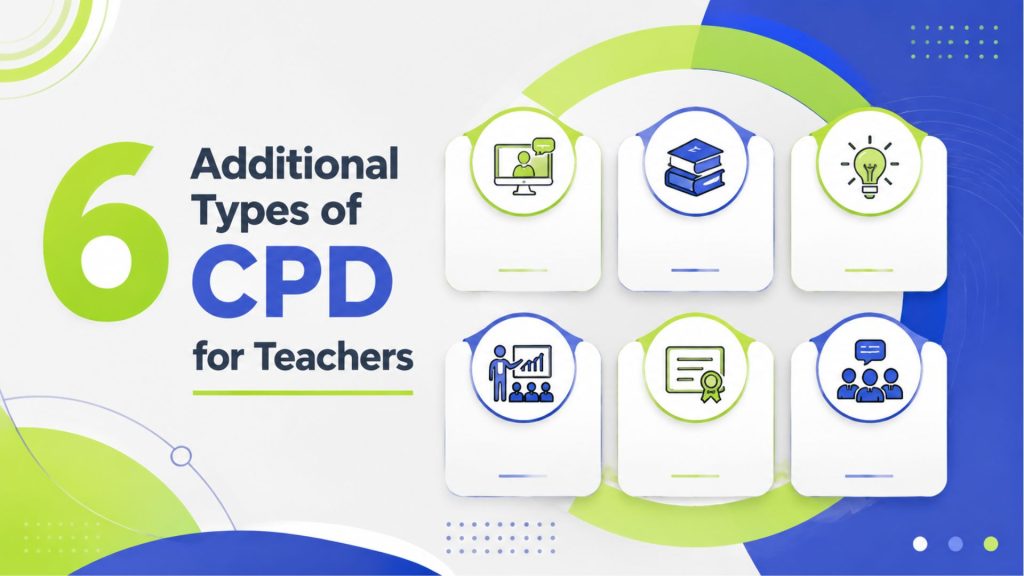
6 Additional Types of CPD for Teachers
Most teachers are familiar with the traditional forms of CPD — formal courses, INSET days, peer observation, and reflective practice. But the world of professional development has evolved significantly, and so have the ways in which teachers can access, experience, and record their learning.
The types covered in this section go beyond the conventional and reflect how modern educators are actually developing their practice today — through digital platforms, specialist conferences, online communities, subject associations, and a growing range of flexible, accessible formats. Each of these represents a legitimate and increasingly valued form of CPD for teachers, and together they open up a much richer landscape of professional growth than any single format could provide.
1. Online CPD and E-Learning
Online CPD has transformed the professional development landscape for teachers — and not before time. The practical constraints that have historically limited teachers’ access to CPD — cost, geography, timetabling, cover arrangements — are significantly reduced when learning can be accessed from anywhere, at any time, on any device. For busy teachers juggling planning, marking, pastoral responsibilities, and everything else the job demands, the flexibility of online CPD is not a luxury. It is often the difference between development happening and not happening at all.
The TeacherTapp State of CPD report found that teachers have a strong preference for online CPD, particularly for its ability to fit around the realities of their professional and personal lives. Online courses, webinars, video lectures, and interactive modules allow teachers to engage with high-quality content at the time and pace that works for them — pausing, rewinding, and revisiting as needed in a way that a live training session simply cannot accommodate.
The range of online CPD available to teachers has expanded enormously. Subject associations run online professional development programmes. Universities offer postgraduate modules and CPD certificates entirely online. Specialist organisations provide evidence-based training in areas like reading instruction, assessment for learning, behaviour management, and educational technology. The challenge is no longer access — it is quality evaluation. Not all online CPD is equal, and teachers investing their development time in online content deserve assurance that what they are accessing meets a professional standard.
2. Subject Associations and Specialist Networks
One of the richest and most underutilised CPD resources available to teachers is their subject association. Every major curriculum subject in UK education — and many around the world — has an association that exists specifically to support teachers in developing their subject knowledge, pedagogy, and professional community. The National Association for the Teaching of English (NATE), the Association for Science Education (ASE), the Geographical Association, the Historical Association, the Mathematics Association — these organisations offer a depth of subject-specific expertise that generic whole-school CPD simply cannot match.
Subject association CPD comes in many forms: conferences, journals, online courses, resource libraries, regional networks, and specialist study groups. For secondary teachers working in subject departments, these associations provide connection to a national community of colleagues who share their specialism — a particularly valuable resource for teachers of minority subjects who might feel professionally isolated in their own schools.
Primary teachers benefit too, particularly from associations focused on core subjects like mathematics and literacy, where the depth of subject knowledge required to teach well is often underestimated and under-supported. The work of organisations like the National Centre for Excellence in the Teaching of Mathematics (NCETM), which offers structured subject knowledge development through its Mastery Specialist programmes, exemplifies what high-quality subject-specific CPD looks like for primary practitioners.
3. Educational Conferences and CPD Events
Attending a well-chosen educational conference is one of the most energising CPD experiences a teacher can have. Not because conferences are always perfectly organised or because every session is a revelation — but because being in a space with hundreds of other educators who are equally committed to their profession creates a kind of professional electricity that is very hard to manufacture any other way.
The teacher conference landscape has diversified significantly in recent years. ResearchED — a grassroots movement of teacher-led, evidence-informed conferences — has grown from a single event in London to a global series of one-day conferences where teachers and researchers share findings and ideas in accessible, practically focused sessions.
Diverse Educators, WomenEd, and other advocacy-focused organisations run conferences that combine professional development with community building. Subject associations host annual conferences that bring together specialists from across the country. And the growth of virtual conferences has made conference-based CPD accessible to teachers who cannot attend in person.
Educational conferences are also one of the best contexts for expanding your professional network. The connections made in a conference session, over lunch, or in the conversations that spill out into the car park afterward can lead to collaborations, mentoring relationships, and professional friendships that enrich a teacher’s career for years. CPD that builds community is some of the most durable and motivating development available.
4. Leadership Development and Career-Stage CPD
CPD for teachers is not one-size-fits-all, and the development needs of a newly qualified teacher are very different from those of an experienced classroom practitioner, a middle leader, or an aspiring headteacher. Recognising this, a range of CPD frameworks and programmes have been developed specifically to support teachers at different career stages.

For early career teachers, the Early Career Framework (ECF) in England provides a structured two-year induction programme backed by research evidence and delivered through a combination of mentoring, training, and independent study. Equivalent programmes exist in other jurisdictions under different names, but the underlying principle is the same: the first years of a teaching career are a critical period for professional formation, and structured support during this time significantly improves both teacher effectiveness and retention.
For teachers moving into middle leadership — as heads of department, year group leaders, or curriculum leads — programmes like the National Professional Qualification for Middle Leadership (NPQML) in England provide structured development focused on the specific competencies that leadership roles require. For aspiring headteachers, the National Professional Qualification for Headship (NPQH) provides a rigorous pathway of study, mentoring, and practical experience that prepares candidates for the demands of school leadership.
Beyond formal qualifications, leadership CPD also includes coaching for leaders, governance training, systems thinking, strategic planning, and the kind of sustained reflective practice that allows leaders to examine their own impact on the school culture and outcomes they are responsible for. The best school leaders are, in many ways, the best learners — and their CPD sets the tone for the development culture of the whole school.
5. EdTech and Digital Skills CPD
Technology has changed teaching — and teachers who do not engage with CPD in this area risk falling behind in ways that directly affect their students’ learning experience. EdTech CPD encompasses the full range of learning about how digital tools, platforms, and approaches can be used effectively — and critically evaluated — in the classroom.
This is not just about learning to use a specific platform or app. The most valuable EdTech CPD helps teachers develop a critical, pedagogically grounded approach to technology — understanding when and why digital tools enhance learning, and when they are a distraction or a shortcut that reduces rather than deepens understanding. Artificial intelligence is now adding a new and urgent dimension to this challenge, with AI tools being used by both teachers and students in ways that raise profound questions about pedagogy, assessment, integrity, and the fundamental purposes of education. CPD in this space is not optional — it is an increasingly pressing professional necessity.
Schools, local authorities, subject associations, and specialist EdTech organisations all offer CPD in this area, ranging from practical hands-on training with specific tools to deeper professional enquiry into the principles of effective technology integration. CPDQE Quality Ensured accreditation is particularly valuable in the EdTech CPD space, where the proliferation of provider-led training that is more promotional than educational makes independent quality assessment especially important.
6. Wellbeing and Pastoral CPD
Teaching is a profession with significant wellbeing challenges. Workload, emotional labour, the demands of pastoral responsibility, and the pressures of accountability all take their toll. CPD that supports teachers’ own wellbeing — and that develops their capacity to support the wellbeing of their students — is increasingly recognised as an essential component of a rounded professional development offer.
Wellbeing CPD for teachers covers a broad spectrum. It might include training in trauma-informed approaches to working with vulnerable students, mental health first aid certification, understanding and supporting students with special educational needs and disabilities (SEND), or developing the classroom management skills that reduce the emotional exhaustion that comes from consistently chaotic learning environments.
It also increasingly includes CPD focused on teacher wellbeing directly — building sustainable working habits, developing emotional regulation strategies, and creating the conditions for a teaching career that can be sustained with genuine engagement and satisfaction over decades rather than burning out in the first five years.
Schools that treat wellbeing CPD as a serious professional development priority — rather than a one-off session on a wellbeing INSET day — see the benefits in staff retention, engagement, and the quality of pastoral care that their students receive. The two are inseparable: teachers who are supported and well can support and teach their students far more effectively.
How to Build a CPD Plan That Works for Teachers
Understanding the types of CPD available is only the beginning. The teachers who get the most from professional development are the ones who approach it with intention — who connect their learning to specific goals, choose activities that genuinely address their development needs, and build habits of reflection that make every experience a source of professional growth.
Start with an honest self-assessment. Where are your genuine strengths as a teacher? Where do you feel least confident — in your subject knowledge, your pedagogical repertoire, your classroom management, your understanding of your students’ needs? What feedback have you received from observations, appraisals, or your own reflective practice that points to areas for development? This honest audit is the foundation of any CPD plan that will actually change your practice rather than simply adding activities to a portfolio.
Set goals that are specific and meaningful. Rather than ‘I want to improve my use of assessment’, try ‘I want to develop my use of formative assessment strategies in Year 9 science so that I can better identify and address misconceptions before they affect exam performance.’ That specificity makes it far easier to choose the right CPD activity, measure your progress, and reflect honestly on the impact.
Choose CPD that matches both your goals and your learning style. If you learn best through discussion and collaboration, a professional learning community or peer coaching relationship will serve you better than a solo online module. If you value depth and rigour, a formal course or action research project will be more developmental than a conference session. The best CPD is not the most prestigious or the most expensive — it is the type you will engage with fully and learn from genuinely.
Balance your CPD across types. A portfolio that is entirely formal and accredited may look impressive but misses the breadth that informal reading, reflective practice, and collegial learning provide. A portfolio that is all informal and self-directed may not meet professional registration requirements and may leave significant development needs unaddressed. Aim for a mix that reflects the full range of ways in which you actually grow as a professional.
And always reflect. Whatever CPD you complete — a conference, a course, a coaching conversation, or a quietly transformative podcast episode — take the time to write down what you took away and how you plan to apply it. That reflection is not an administrative formality. It is where the learning actually happens.
Final Thoughts
Teaching is a profession that demands continuous growth. The students in our classrooms deserve teachers who are not just experienced but genuinely excellent — who bring current knowledge, refined skills, and fresh perspectives to their practice every single day. CPD is how that standard of excellence is maintained and developed over the course of a career.
The landscape of CPD available to teachers has never been richer. From the rigour of formal accredited programmes and the depth of action research, to the accessibility of online learning and the community of professional learning networks, there is a form of professional development that works for every teacher — regardless of their subject, phase, career stage, budget, or schedule.
The teachers who make the most of it are not necessarily the ones who do the most. They are the ones who do it with intention — who know what they are trying to develop, choose their activities with care, reflect honestly on what they learn, and let their CPD actually change how they teach. That combination of curiosity, discipline, and genuine commitment to growth is what makes a great teacher — and it is what CPD, at its best, exists to support.
Jordan Henderson is a well-known writer and CPD research analyst with extensive experience creating insightful content on professional development, workplace learning, leadership, compliance, and skills development.
Would you know what to do in the first sixty seconds if a colleague collapsed, a child started choking, or someone near you stopped breathing? Most people freeze, not through lack of care, but because nobody has ever shown them what to do.
The good news is that you can build that confidence without leaving your desk. The best CPD first aid courses right now combine three things: a real practical demonstration video so you can see the technique, not just read about it, genuine CPD certification you can log against your professional development record, and content that maps onto real emergencies rather than generic theory.
For most people looking for an accredited, free, video-led option, the Be Ready in an Emergency: First Aid Awareness Webinar, powered by CPDQE is the strongest all-round choice, because it’s free, online, CPD certified, and covers both adult and paediatric first aid in one session. But it isn’t the only option worth knowing about. Below, we compare it against the free British Red Cross workshops and a paid, HSE-aligned classroom qualification from Leeds Beckett University, so you can pick the right course for your situation.
What Makes a First Aid Course Actually Worth Your Time?
A first aid course is worth taking if it teaches you a physical skill you can demonstrate, not just a fact you can recite. Look for three things: video or live practical demonstration, a recognised certificate you can point to, and coverage of the emergencies you’re actually likely to encounter.
Watching someone perform CPR, treat a burn, or manage a choking child is a completely different learning experience to reading a bullet-point list. Video demonstration lets you pause, rewind, and mimic hand placement and rhythm in a way that text never can. That’s why every course we’ve shortlisted below includes a practical, visual teaching element rather than slides alone.
Certification matters too. A CPD certificate gives you evidence of learning you can log for professional development, show to an employer, or add to a CV. A workplace first aid qualification, on the other hand, satisfies a legal requirement rather than a CPD one, and the two aren’t interchangeable, so it’s worth being clear on which one you actually need before you book.
Which First Aid Courses Are Completely Free to Book?
The British Red Cross offers two free, non-accredited options: self-directed online first aid skills training you can work through at your own pace, and a live, instructor-led 90-minute first aid workshop for adults delivered on Microsoft Teams or face to face.

The self-paced online pages let you learn CPR, choking response, and wound care through short videos and a free companion app, at zero cost and with no booking needed. It’s a genuinely useful starting point if you just want to build baseline confidence.
The live workshop goes further, with an experienced Red Cross educator taking you through hands-on techniques for CPR, bleeding, burns, and stabilising injuries using everyday household objects. It’s worth knowing this workshop has eligibility limits: it’s aimed at community members and non-profit organisations, not paid staff, individual parents, or anyone specifically seeking baby and child first aid, and group bookings need between 5 and 15 people. It’s also a workshop of learning rather than a formal qualification, so you’ll get a self-completed certificate of learning rather than CPD points or a legally recognised certificate. If you fall outside that eligibility window, the Red Cross points you toward its accredited Red Cross Training courses instead.
What’s the Best Paid, Workplace-Compliant First Aid Course?
If you need a legally recognised qualification for your workplace, Leeds Beckett University’s First Aid at Work with AED (three days) is the strongest paid option, priced at £269 with sessions running throughout 2026 at its Headingley Campus in Leeds.
This is a competency-based course built to the standards required by UK health and safety law, with First Aid Industry Body (FAIB) approval and built-in Automated External Defibrillator (AED) training in line with British Heart Foundation recommendations. Candidates practise CPR, choking response, wound and bleeding management, and how to respond to conditions like anaphylactic shock, seizures, strokes, and suspected spinal injuries, then sit a practical assessment before receiving a First Aid at Work certificate valid for three years.
This is the right choice if your employer needs a nominated, qualified first aider on site rather than a general awareness certificate. It’s a three-day, in-person commitment though, so if you just want CPD-recognised awareness training you can complete online in an hour or two, one of the options below will suit you better.
Which Online CPD First Aid Course Offers the Best Overall Value?
For most people who want free, online, CPD-certified training with a genuine practical demonstration, the Be Ready in an Emergency webinar powered by CPDQE is the best overall pick. It runs on Thursday 16 July 2026 from 5:00pm to 6:30pm UK time, entirely online, and is completely free to attend.
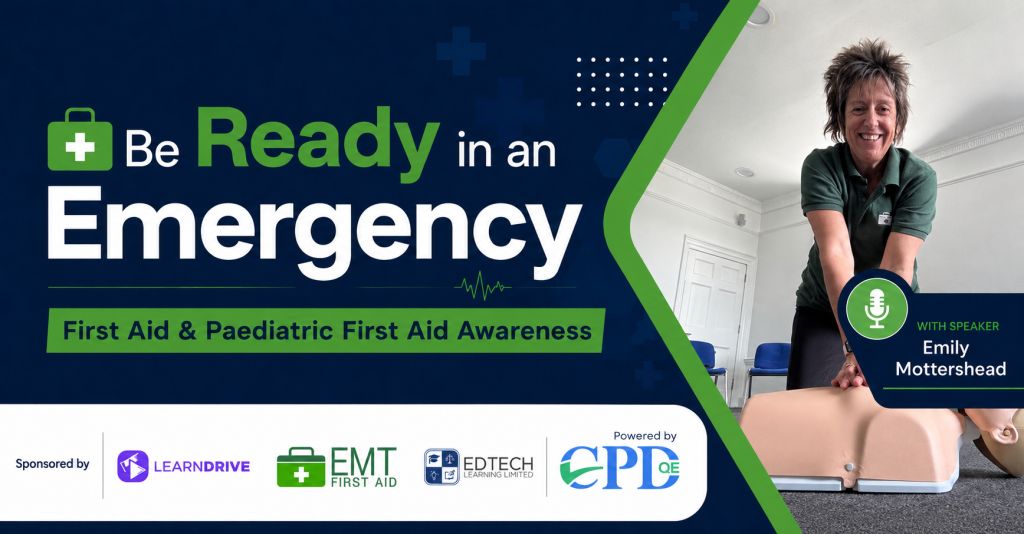
The session is led by Emily Mottershead and introduces the essential principles of both First Aid and Paediatric First Aid in a single, practical webinar.
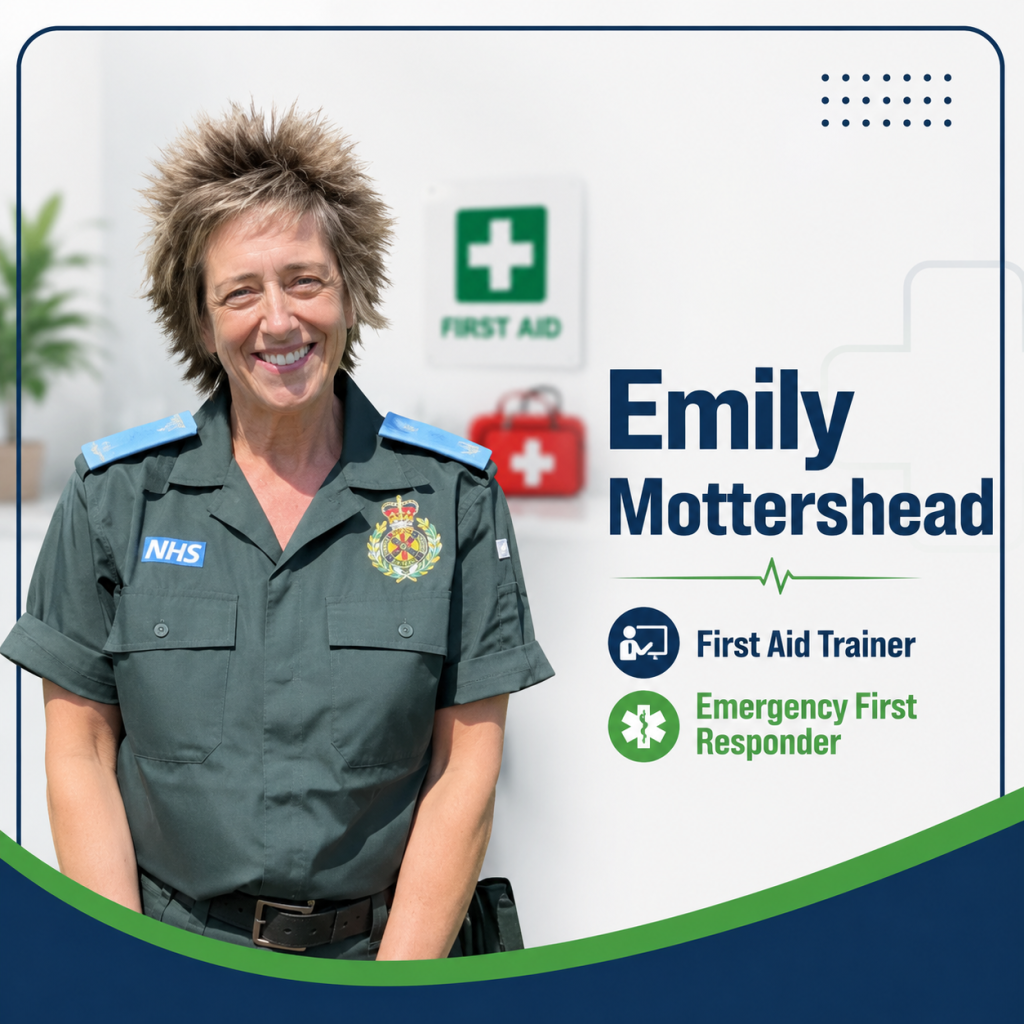
That combination matters, because most free community workshops only cover adult scenarios, while dedicated paediatric courses are usually paid. Covering a choking toddler, a colleague collapsing at their desk, and a child having an asthma attack in the same session means you leave with a broader, more useful skill set than a single-topic course provides.
Unlike the Red Cross community workshop, this webinar is open to a general audience rather than restricted to non-profit groups, and it’s CPD certified through CPDQE, so you can log the hour against your professional development record and order a certificate afterwards. If you only book one course from this list, this is the one that gives you the widest coverage for zero cost.
What Should a Good CPD First Aid Course Actually Cover?
A comprehensive CPD first aid course should cover CPR, choking, burns, bleeding, drowning, seizures, heatstroke, and the effects of intoxicants, alongside the practical basics of infection control, incident management, and the recovery position.
Beyond the technical skills, a genuinely useful course also teaches you how to assess a scene safely, recognise when someone is unconscious or has stopped breathing, and prioritise care until professional help arrives. If you’re comparing two courses and one only ticks off CPR while the other works through this fuller list, the broader course will serve you better in a real emergency, since you rarely get to choose which type of incident you’re first on the scene for.
What Does UK Law Actually Require for Workplace First Aid?
Under the Health and Safety (First-Aid) Regulations 1981, UK employers must provide adequate and appropriate first aid equipment, facilities, and trained personnel so that employees receive immediate attention if they’re injured or fall ill at work. The exact level of provision depends on a first aid needs assessment specific to that workplace.
These regulations, set out in full on legislation.gov.uk, don’t legally require employers to provide first aid for non-employees such as visitors or members of the public, though the Health and Safety Executive recommends including them in the needs assessment anyway. This is the key distinction to understand before you book a course: if your employer needs you to be their designated, legally compliant first aider, you need a workplace qualification like the Leeds Beckett course above, not a CPD awareness webinar. If you simply want the skills and confidence for yourself, your family, or general professional development, a CPD-certified awareness course covers what you need.
How Much Difference Does Bystander First Aid Training Really Make?
Bystander action makes a measurable difference to survival, yet most people still don’t feel confident enough to act. British Red Cross research on its adult workshop found that around 85% of UK adults wouldn’t know what to do if someone collapsed and stopped breathing.
That gap matters because members of the public already perform CPR in roughly 70% of out-of-hospital cardiac arrests in England, rising closer to 80% when the collapse is witnessed, according to the Out-of-Hospital Cardiac Arrest Outcomes registry reported by Resuscitation Council UK and the British Heart Foundation. Even so, survival to hospital discharge remains low, at roughly one in twelve people. The takeaway isn’t that bystanders aren’t trying, it’s that confident, well-practised technique in those first few minutes genuinely shapes the outcome, which is exactly the gap a well-taught, video-led first aid course is designed to close.
Free vs Paid vs CPD-Certified: Quick Comparison
| Course | Cost | Format | Duration | Certification | Best for |
| Red Cross Learn First Aid | Free | Self-paced online + app | Flexible | Learning only, no certificate | Building baseline confidence solo |
| Red Cross Workshop for Adults | Free | Live, online or face-to-face | 90 minutes | Self-completed certificate of learning | Community groups and non-profits (5-15 people) |
| CPDQE Be Ready in an Emergency Webinar | Free | Live online webinar | 90 minutes | CPD certified | Anyone wanting free, video-led, CPD-recognised adult and paediatric first aid awareness |
| Leeds Beckett First Aid at Work with AED | £269 | In-person, Headingley Campus, Leeds | 3 days | First Aid at Work certificate, valid 3 years | Employers needing a legally compliant, workplace-qualified first aider |
Frequently Asked Questions
Is a free first aid course as good as a paid one? For general awareness and CPD purposes, yes, a well-structured free course like the CPDQE webinar can be just as valuable as a paid one. Paid, multi-day courses like the Leeds Beckett qualification exist for a different purpose: meeting a specific legal workplace requirement, not simply learning the skills.
Do online first aid webinars count as CPD? Yes, provided the webinar is delivered by a CPD-accredited provider. The CPDQE-powered webinar on 16 July 2026 is CPD certified, so attendees can log the session and order a certificate afterwards.
How often should I refresh my first aid training? Workplace qualifications like First Aid at Work are typically valid for three years, with annual refreshers strongly recommended in between. CPD awareness sessions are best repeated periodically too, since hands-on skills like CPR fade without regular practice.
Is the CPDQE webinar suitable for parents and carers? Yes. Unlike the Red Cross community workshop, which excludes individual parents and baby or child-specific requests, the CPDQE webinar covers both adult and paediatric first aid and is open to a general audience, making it a good fit for parents, carers, and anyone responsible for children.
Key Takeaways
- Choose based on your actual need: a legal workplace qualification calls for a course like Leeds Beckett’s First Aid at Work, while personal or professional CPD calls for an accredited awareness course.
- Free doesn’t mean lower quality. Both the Red Cross workshops and the CPDQE webinar are free, but only the CPDQE session is CPD certified and open to everyone, including parents and carers.
- Practical demonstration beats theory alone. The most useful courses on this list all teach through live or video demonstration rather than text and slides.
- Bystander confidence saves lives, and UK data shows there’s still a real gap between how often people step in and how prepared they feel to do it well.
The CPDQE-powered Be Ready in an Emergency webinar on Thursday 16 July 2026 is free, CPD certified, and covers both adult and paediatric first aid in one 90-minute online session. Reserve your free place on Eventbrite before spaces fill up.
By Sam, CPD Accreditation Consultant, CPDQE
Sam is a CPD Accreditation Consultant at CPDQE, working with training providers across the UK to deliver CPD-certified courses and awareness sessions.